

Portugal is one of the Western European states that can be ranked among its Western European counterparts in terms of investment opportunities. The country offers great opportunities for foreign companies looking to invest in fintech, real estate, manufacturing, and trading.
But, in order to make sure that the legitimacy of a given business established in Portugal, one will have to check the data provided by at least four different databases.
This is the main challenge posed by a fragmented compliance team structure. An entity can be registered in law but not with an active tax filing. Moreover, a beneficial owner register can exist without ensuring the legal entity status of the entity.
The authority of the signatories may be stipulated in the incorporation documents that do not appear in a registry search. Thus, it is necessary to learn how these layers interlock to ensure that one can conduct any business verification in Portugal.
Why Portugal Verification Is Harder Than It Looks
Portugal’s RCBE portal is the country’s central beneficial ownership register, which includes a built-in process for reporting omissions, inaccuracies, and discrepancies in filed declarations.
That is an official acknowledgment, on the registry’s own platform, that company-submitted data cannot be taken at face value.
For a compliance team running onboarding checks on a Portuguese counterparty, it means the single source intended to confirm who controls the business may already contain errors that no one has flagged.
Thus, business verification in Portugal is not a single check. It is a reconciliation across four official sources:
- Commercial Registry
- Central Register of Beneficial Owners(RCBE)
- Tax Authority(TA)
- Incorporation documents
Note that none of the above cross-validate each other automatically. A company can be registered in the Registo Comercial while carrying out no tax activity.
Its RCBE filing will state the identity of the natural person as the UBO, even though he is an individual hiding behind a Cypriot holding company whose ownership trace has never been established. It is about knowing the capabilities and limitations of every information source.
How to Verify a Business in Portugal?
Here is a six-step guide to verifying businesses in Portugal
-
Collect The Company’s Identifiers.
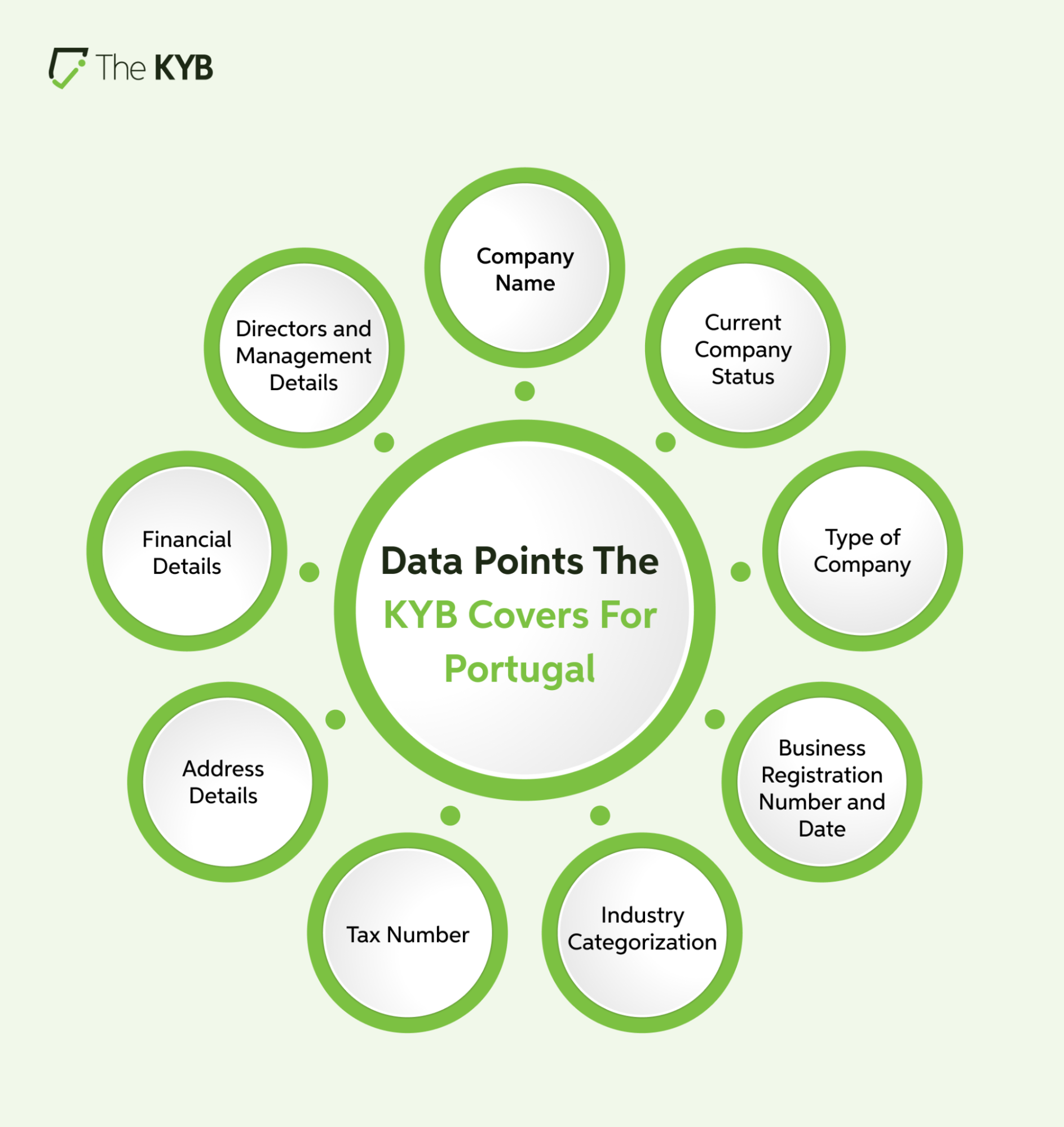
Before accessing any registry, gather the following information: NIPC, the company’s registered name, the CAE activity code, and the registered address. Discrepancies between various sources at this point should be investigated.
-
Search The Commercial Registry
Retrieve the Permanent Certificate. It shows legal form, registered acts, capital, incorporation date, and the latest statutes. Unlike the physical company card, which becomes invalid the moment any information changes, the Permanent Certificate reflects current registry data.
-
Verify Tax Activity Status
Check the Tax Authority records separately. A company active in the Registo Comercial may carry no declaration of commencement of business on file with the AT.
For onboarding, both sources must confirm the same thing: the company is operating, not merely incorporated.
-
Check Beneficial Ownership Via RCBE
Verify the UBO declaration under Law 89/2017 as amended by Law 58/2020. Note the access constraint: the RCBE provides full details only to those with a Portuguese electronic identification.
Foreign compliance teams are mandated to work through a locally licensed professional or a data provider with direct registry access.
-
Review Signatory Authority
Portuguese incorporation documents specify how the company is legally bound by signature, not just who manages it.
A director appearing in the registry may have limited signing authority. Confirming who can actually execute contracts requires reviewing the articles of association, not the registry extract.
-
Run Cross-Border Checks
For EU trade relationships, VIES confirms VAT registration, and BRIS enables cross-EU registry searches. Both are useful supplements. Neither covers UBO transparency, tax activity status, or signatory authority.
Explore the Fundamental Challenges in Portugal Company Verification
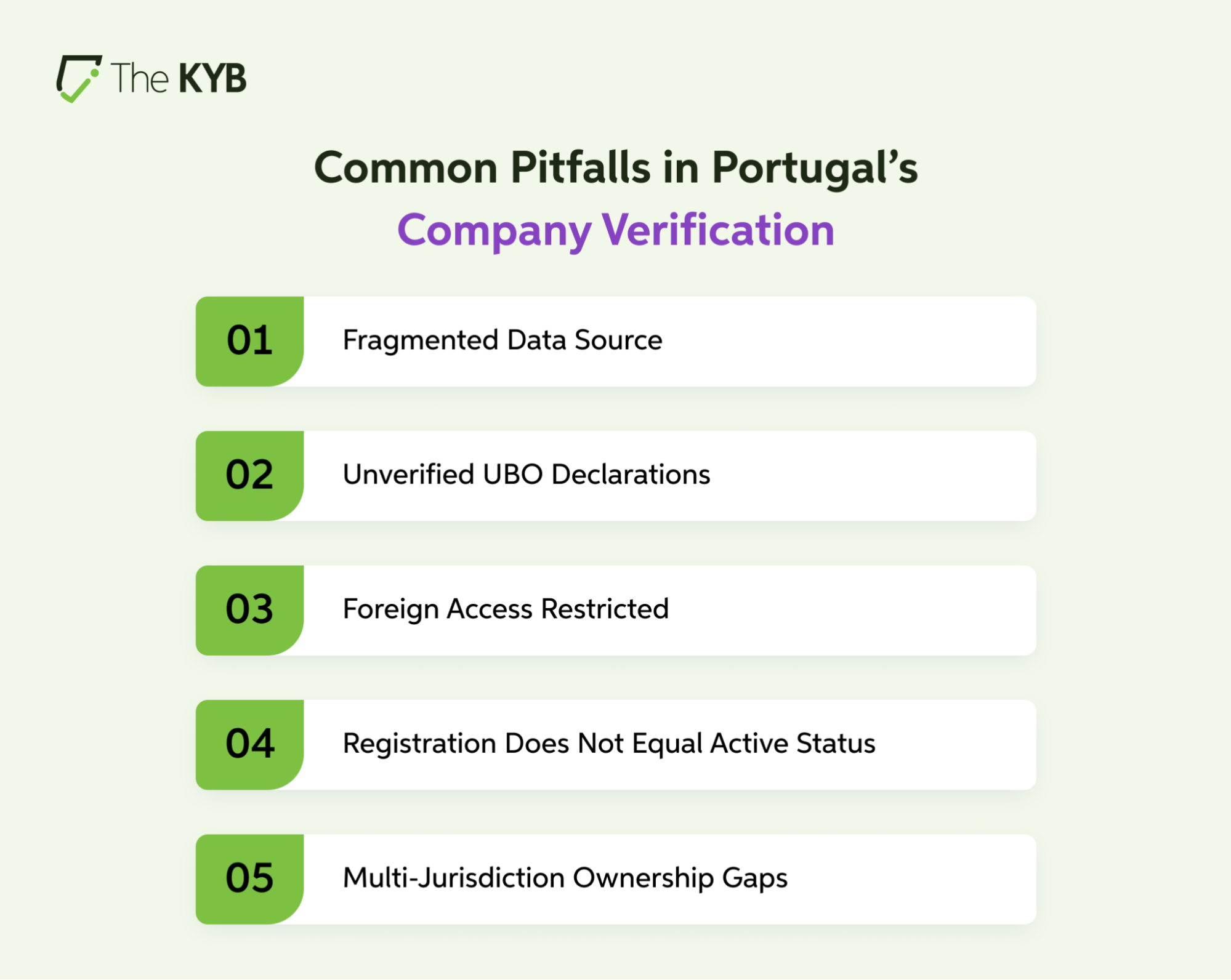
Beneficial Ownership Is Not Self-Certifying.
The RCBE holds self-filed declarations. Its own portal acknowledges that omissions and inaccuracies exist, and it does not constitute proof of the entity’s legal status.
Registration Does Not Equal Operational Status.
The Tax Authority and Commercial Registry are separate, non-communicating systems. Confirming active status requires both checks.
Static Documents Age Quickly.
Name changes, head office relocations, and amendments each invalidate the physical company card. Verification based on a PDF sent by the counterparty is working from data of unknown vintage.
Signatory Authority Can Be Obscured.
Binding authority is defined in the articles of association, not in the registry extract. Registry-only verification leaves this gap open.
Foreign Access to RCBE is Restricted.
Without a Portuguese e-ID, available only to residents, citizens, and taxpayers, the international teams cannot retrieve RCBE records directly.
Regulated Sectors Require Extra Checks.
For financial services, real estate, and industrial businesses, Portugal company verification must include sector-specific licensing checks alongside the standard registry workflow.
How Multi-Jurisdiction Structures Hide Beneficial Owners in Portugal
In Portugal’s RCBE regime, the UBO can never be an organization; it must be a natural person. The consequences for non-compliance include penalties of €1,000 to €50,000, prohibition of dividend payments, and denial of access to public procurement contracts.
The harder problem is what the RCBE does not surface. A Portuguese Sociedade por Quotas may list a Cypriot holding company as its sole shareholder.
The RCBE declaration names a natural person as UBO, but that declaration is self-filed and unverified against the Cypriot entity’s own ownership records.
Where nominee arrangements or multi-jurisdiction structures are in place, the RCBE reflects the stated structure, rather than the real one. Tracing actual control requires UBO identification across each relevant jurisdiction, not just Portugal.
How The KYB Supports Portugal Business Verification
Manual reconciliation across four disconnected sources is time-consuming. When the RCBE is inaccessible to foreign teams without a Portuguese e-ID, the process becomes structurally blocked without the right infrastructure.
The KYB pulls commercial registration, UBO, and legal status data directly from official Portuguese government sources, not from aggregated third-party databases or re-licensed data.
This difference is important for regulatory examinations because aggregated information can become outdated or disputable. Information provided by official sources or registries is up-to-date and ready for audits.
The KYB’s UBO verification drills down into complex corporate hierarchies to reveal the actual individuals who own corporations, filling the gap missed by RCBE screening alone.
Moreover, constant KYB screening detects changes in management, ownership, and potential sanctions risks that arise following the completion of the initial screening.
A sanctioned entity operating through a Portuguese shell whose beneficial ownership was never properly traced is a regulatory examination failure waiting to happen.
Book a demo to learn more about The KYB solution for Portugal company verification.
Frequently Asked Questions
How to Check Company Registration in Portugal?
Access Empresa Online and retrieve a Permanent Certificate using the company’s name or NIPC. It shows current legal status, incorporation date, registered office, directors, and latest statutes.
How Can You Verify a Company in Portugal?
Verifying a company in Portugal requires checks across four sources: the Commercial Registry, the RCBE, the Portuguese Tax Authority, and the articles of association. The KYB can help verify companies by fetching data from official registries.
How to Check Company Status in Portugal?
Company status is confirmed through the Permanent Certificate from the Commercial Registry, which reflects real-time legal standing. Active, dissolved, and defunct statuses appear in both the Permanent Certificate and the FCPF certificate.