
A business does not always look like a corporation on paper. Sometimes, it is one person selling products online, running a consulting service, or operating a small logistics business with inadequate proof of business registration.
There may be no complex ownership structure, no shareholder filings, and no long corporate history. That does not mean the business is fake. It means the business is a sole proprietorship, and for compliance teams, that creates a unique KYB challenge.
The traditional KYB processes were designed for registered companies, incorporation records, directors, shareholders, and structured filings. Sole proprietorships may have fewer official records, making verification more difficult.
Thus, business verification is not a challenge anymore for banks, fintechs, marketplaces, or regulated businesses. Instead, it’s about assessing if a low-documentation business is a viable, operating, and secure company to join.
What is a Sole Proprietorship in KYB?
The definition of a sole proprietorship, as per Know Your Business(KYB), is a business owned and run by a single person. In many jurisdictions, the owner and the business are not disconnected entities but are linked.
The company may have a legal name and/or a trade name (also known as a DBA). Depending on the state and sectors, the business may require tax registrations, permits, invoices, or a business bank account. In other instances, there might be less documentation.
This is why KYB for sole proprietorships often overlaps with verifying identities. Businesses are mandated to check both the commercial activity and the individual behind it.
Unlike corporations, sole proprietorships may not have:
- Shareholder structures
- Incorporation documents
- Extensive registry records
- Public ownership information
That makes traditional verification workflows less effective.
Why Sole Proprietorships are Difficult to Verify
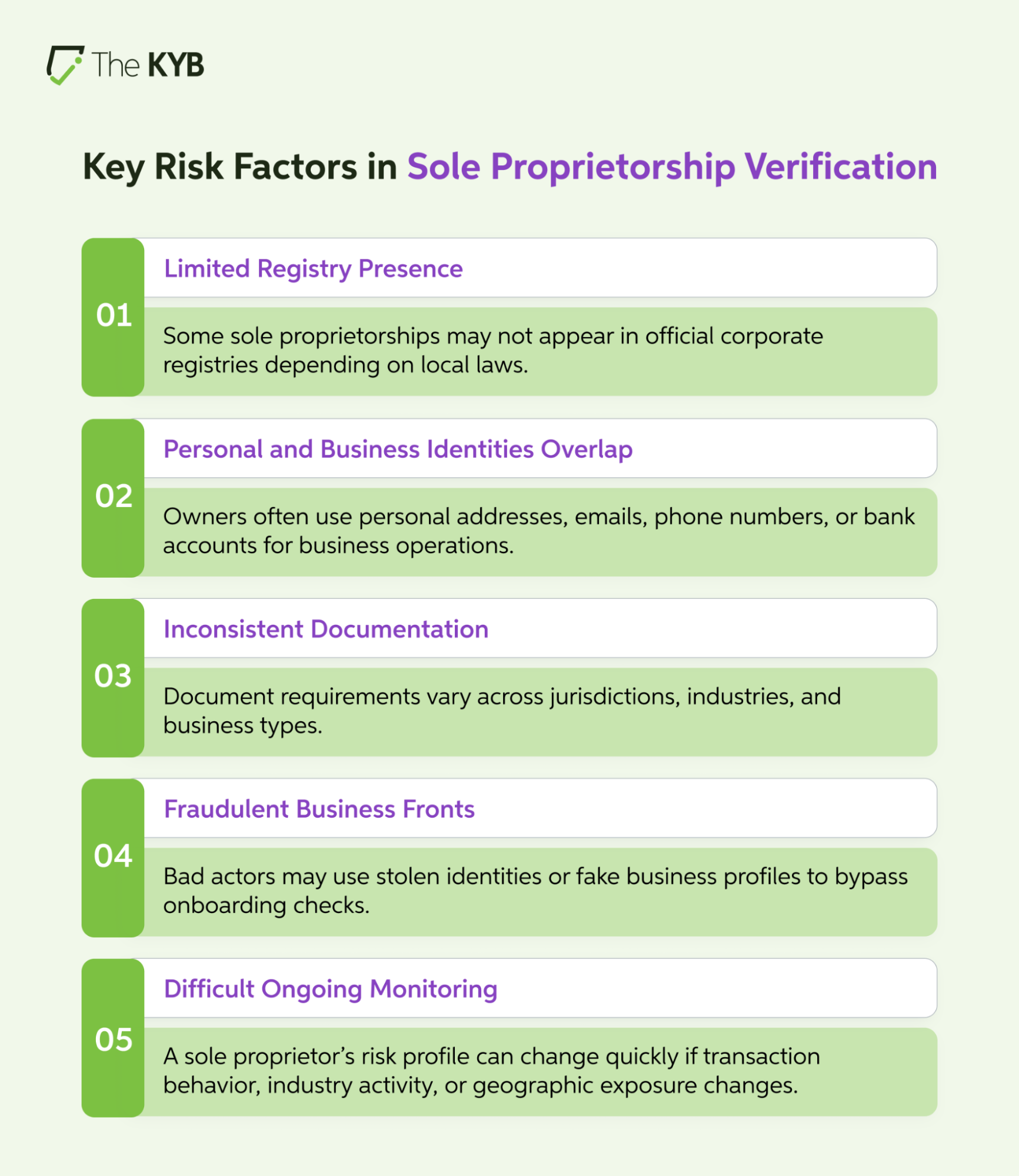
Individuals who are sole proprietors frequently include freelancers, creators, local businesses, consultants, and those who sell items online. The challenge is that many do not leave the same corporate paper trail as incorporated companies.
For example, a conventional KYB compliance system may ask for an incorporated company’s registration number, incorporation certificate, or beneficial ownership structure. However, a sole proprietor may lack any of these documents, which restricts the ability to proceed with onboarding.
Legitimate businesses may be subjected to manual review simply because their operating methods differ from those of an incorporated business. As well, fraudsters exploit the low-documentation requirements to create fake stores, synthetic businesses, and mule-type operations.
This creates two dangerous extremes:
- Rejecting genuine businesses because they fail to maintain the requisite formal records
- Lowering verification standards and increasing fraud exposure
The smarter approach is risk-based KYB.
Documents Required for Sole Proprietorship KYB
The exact requirements depend on the state, sector, and risk level they hold. However, most compliance teams request a combination of identity documents, business proof, and operational evidence.
| Document Type | Purpose |
| Government-issued ID | Verifies the identity of the owner |
| Proof of address | Confirms residential or business location |
| Business registration certificate | Verifies legal business registration where applicable |
| DBA or trade name certificate | Confirms the operating business name |
| Tax identification document | Confirms tax registration status |
| Business license or permit | Validates legal authorization to operate |
| Bank statement | Shows financial activity and account ownership |
| Utility bill or lease agreement | Supports address verification |
| Invoices or supplier contracts | Demonstrates active business operations |
| Website or marketplace profile | Supports digital business presence |
| VAT or sales tax registration | Confirms tax compliance where required |
| Professional license | Required for regulated industries and businesses |
The key is that verification should be commensurate with risk. A low-risk freelancer and a high-volume cross-border merchant should not go through the same onboarding process.
The Biggest Mistake Companies Make
One of the biggest mistakes is treating sole proprietorships like incomplete corporations. They are not incomplete. They are structured differently. They’re organized in a different way. A sole trader has no shareholders, since there are none.
They may not have incorporation records because the business is not incorporated. That does not automatically make the business suspicious. The better approach is to verify what actually matters:
- Is the owner real?
- Is the business operational?
- Are the submitted details consistent?
- Is the business legally allowed to operate?
- Are there sanctions, adverse media, or regulatory concerns?
This approach helps businesses reduce fraud while avoiding unnecessary rejection of legitimate customers.
What Should Be Verified Beyond Documents?
Documents alone are no longer enough. A sole proprietorship may have valid paperwork and still present a risk. Another may have limited documentation but show strong signs of legitimate business activity.
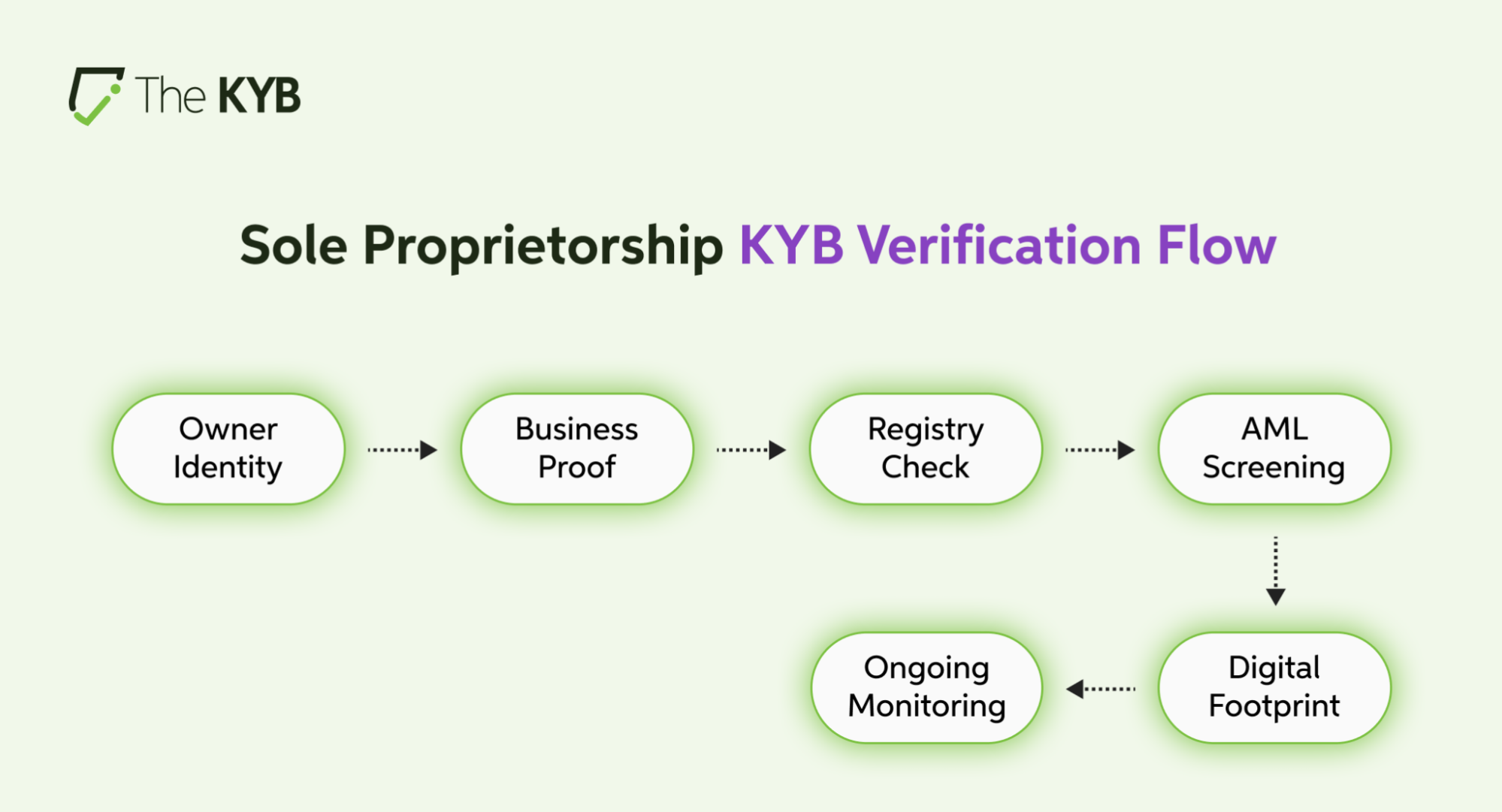
This is why modern KYB combines documentation with data-driven verification. Key checks include:
- Owner Identity Verification
- Business Legitimacy Checks
- Registry Intelligence
- AML and Risk Screening
- Ongoing Monitoring
Modern KYB is no longer just document collection, but an intelligence-driven verification.
How The KYB Supports Sole Proprietorship Verification
The KYB helps businesses streamline verification with access to official registry intelligence, business verification, risk assessment, UBO identification, and ongoing monitoring capabilities.
For sole proprietorships, this matters because compliance teams often need more than a static document checklist. They need to connect owner identity, business activity, registry data, and AML intelligence into a single verification workflow.
The platform supports:
- Business verification across global registries
- Corporate screening and AML checks
- Risk assessment workflows
- Ongoing monitoring and perpetual KYB
- Verification support for merchant onboarding and vendor screening
This is especially useful for sole proprietorships because the owner is often the central risk point. Screening only the business name may not be enough. Businesses may also need to assess the individual behind the operation.
Why Ongoing Monitoring Matters
Most companies view KYB verification as a one-time process, but such a strategy carries risks. A sole proprietorship may easily change from one industry, transaction type, or geographic location to another. The chance of new sanctions list release, adverse media, or suspicious activity can occur post-onboarding as well.
Thus, ongoing monitoring, also known as perpetual KYB, enables businesses to continuously keep a track of these changes rather than rely on outdated onboarding information.
Especially for sole proprietorships, this is crucial as the owner and business are closely connected to each other. Additionally, the business relationship can be affected by changes in the individual’s risk profile.
How The KYB Helps with Sole Proprietorship Verifications
Sole proprietorships are becoming a larger part of the global economy. The freelancer, online merchant, consultant, creator, and micro-business are the new members being added onto financial platforms and marketplaces on a massive level.
The difficulty is that many of these businesses can’t be connected to the traditional corporate verification model.
Compliance teams are required to check the business without imposing unnecessary workflows on small businesses. At the same time, they must be able to recognize the potential for fraud in low-documentation environments.
Smarter verification, registry intelligence, AML screening, risk assessment, and monitoring will be critical to the future of KYB for sole proprietorships.
Thus, The KYB is a step beyond mere document verification for businesses, enabling them to create more robust verification procedures for sole proprietors, small business owners, and corporate entities.
Looking to verify businesses more than just paper? Learn about the KYB’s use in business verification, corporate screening, and risk-based onboarding.