

KYB checks were created to answer a simple question before a business is onboarded: Is this company real, authorized, legal, and a safe deal to sign an agreement with?
That question sounds simple. In reality, it has become harder to answer. Fraudsters are no longer only using fake personal IDs or stolen documents.
They are building fake business identities, hiding risky owners behind layers, creating shell companies, and using AI-generated material to look credible during onboarding.
This is where KYB bypass becomes a serious compliance risk. KYB bypass happens when a company manipulates, hides, or fabricates business information to pass Know Your Business checks.
The business may appear registered, and the documents also appear valid. Further, the company’s website may seem active too. But behind that clean surface, the real ownership, risk exposure, or business activity may tell a very different story.
What Is KYB Bypass?
KYB bypass is the practice of getting business verification controls during onboarding or ongoing monitoring of a business identity.
The procedure can involve fake documents, hidden ownership, misleading company structures, nominee directors, shell companies, synthetic business identities, or AI-generated business profiles.
The goal is simple: make a risky or fake business look safe enough to enter a financial platform, marketplace, payment system, or regulated business relationship.
This does not always mean the company is entirely fake. Sometimes the company exists legally, but the risk is hidden. A registered company can still be used to commit offenses, including money laundering, sanctions evasion, or other financial fraud, if the real people behind it are not properly verified.
That is why modern KYB cannot stop at “does this company exist?” It must also ask: who owns it, who controls it, what it is connected to, and whether its activity makes sense.
Why Bypassing KYB Checks Has Become Easier
KYB checks were once a genuine gatekeeping mechanism. Now, bypassing them has become easier, as many onboarding methods still rely on surface-level verification.
The documents usually required for business incorporation include proof of address, tax details, and director information. If the application papers look clean, they go through. That’s the problem. These workflows have been very well understood by fraudsters.
They understand which registries don’t delve deep, the limited scope of verification teams, and what checkpoints are more of a show than a check-in.
This has been further refined by AI. Once, time and resources were needed to develop a convincing website, a believable founder profile, and a fake paper trail of business history. Now it can be put together in a few hours. To appear valid on the surface, it can be invoices, contracts, or supporting documents.
By the time your staff opens their email inbox, a company that doesn’t exist today could have a website, a business domain, social networking profiles, and a realistic company story. That’s not hypothetical. It’s happening.
The playing field has changed for compliance teams. They are not only checking documents anymore. They are checking whether an entire business identity is real.
What are the Common KYB Loopholes Fraudsters Exploit
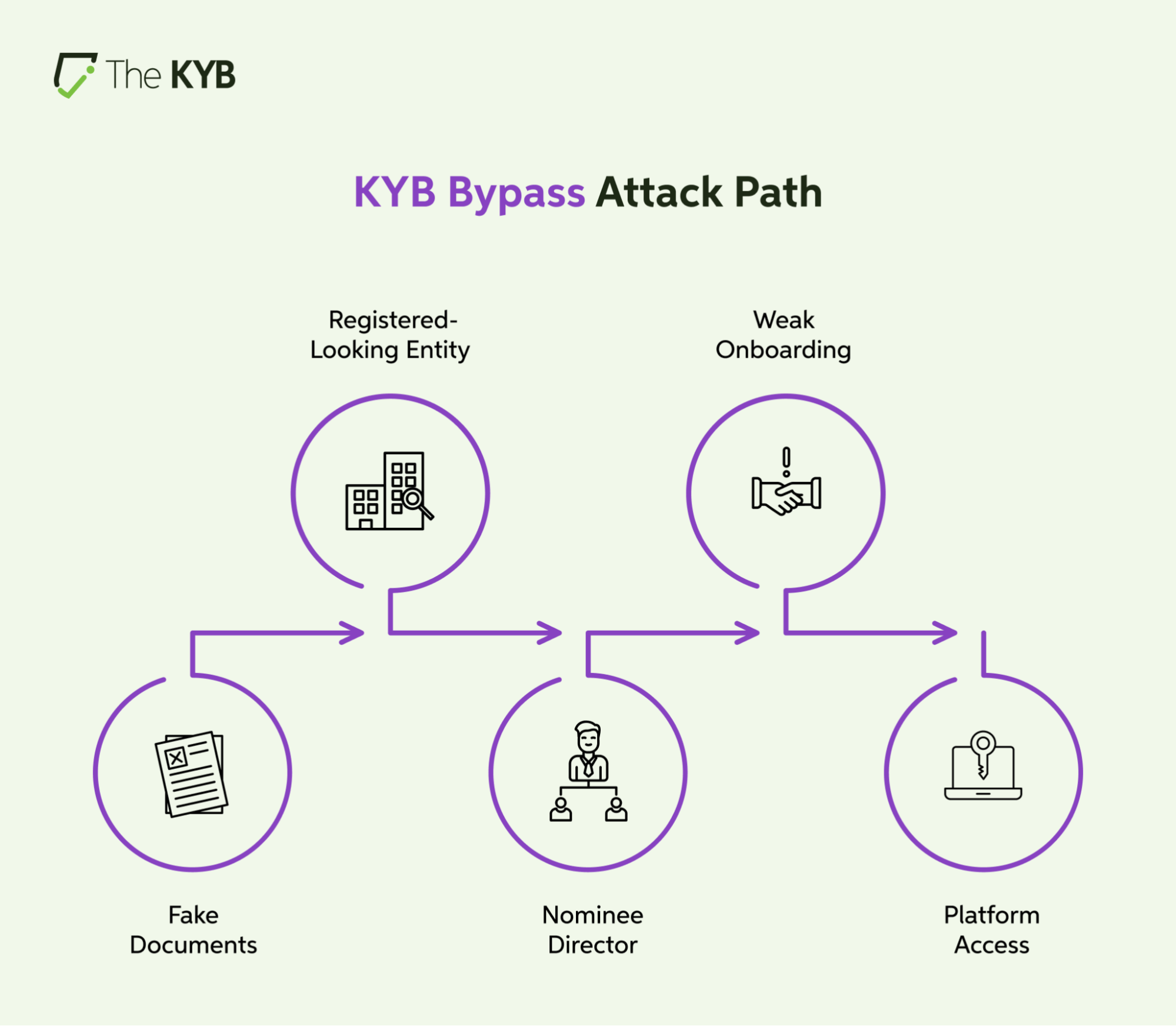
Fraudsters don’t break through KYB; they slip around it. Typical KYB loopholes include limited ownership verification, inadequate registry coverage, verification of documents alone, and monitoring that ends the moment a client is approved.
If a company is only inspected once, it can pass onboarding and then change ownership, business activity, or risk exposure later.
If UBO checks are weak, risky individuals can hide behind nominee shareholders or layered entities. If adverse media is not checked, businesses linked to investigations or negative reports may pass unnoticed.
Another major loophole is relying only on official registration. A company can be legally registered and still be used for illegal activity. Registration proves existence. It does not prove trust.
Strong KYB needs to connect multiple signals: registry data, UBO information, sanctions exposure, watchlists, PEP connections, adverse media, and ongoing changes.
How KYB Bypass Takes Place in Shell Companies
A shell company KYB bypass is simple in practice that includes registering a business that looks real, pass verification, and keep the actual owners or intent buried underneath.
Shell companies are dangerous because they can look normal. They may have registration documents, directors, addresses, and bank details. Some may even have websites and basic business records.
But their real function may be to obscure ownership, move money, hold assets, or create a clean-looking layer between a risky person and a regulated service. A shell company does not need to look suspicious. That is exactly why it works.
For compliance teams, the challenge is to look beyond the company name and registration number. Who benefits from the company? Who controls it? Are there unusual ownership layers? Are the directors connected to other high-risk entities? Does the business activity match its footprint?
Without these checks, shell companies can pass basic onboarding with surprising ease.
KYB AI Fraud: The New Bypass Layer
KYB AI fraud is changing how business verification risk works.
Using AI can help fraudsters generate fake business documents, synthetic executive profiles, artificial company histories, fabricated invoices, contracts, and professional-looking websites.
They can even produce deepfake videos or identity materials to assist in verifying the director or owner.
This makes fake companies even harder to identify, as the fraud appears more complete. These can be a registered company, a well-designed website, a business email, and a set of documents in a weak KYB system.
However, those signals might have been generated during the onboarding process. The danger of AI is not just that it can forge documents. The bigger issue is that AI can create an entire fake business environment around those documents.
How to Detect Bypassing KYB Verification
Detecting bypassing KYB verification requires a layered approach.
These should involve checking business registrations with recognised organisations, identifying UBOs, checking for ownership layers, screening directors, shareholders and individuals for sanctions, watchlists, politically exposed persons (PEPs) and matching the declared business activity of a company with its physical presence.
- Does the website look newly created?
- Has the company stated they are global in nature but no operating history can be found?
- Do directors have connections to multiple unrelated groups?
- Is the ownership structure unusually complex for the company type?
The answers to these questions can be important as inconsistencies are frequently hidden in the company’s KYB layout.
In addition, ongoing due diligence is also a requirement. A company that is low risk now can turn to be high risk if someone takes ownership of the company, the government gets involved, the company is sanctioned, or it gets bad publicity. This means that a single KYB check won’t be enough to make sure of compliance.
Why Basic KYB Checks Are No Longer Enough
Basic KYB checks answer only part of the problem. They may confirm that a company exists, but not whether it is safe. They may confirm a document is present, but not whether the business is being used as a front. They may identify a director, but not the real controller behind the structure.
The paradigm shift in modern KYB is from mere document collection towards risk intelligence. This involves authenticity, ownership, control, connected entities, regulatory risk, adverse media and changes over time.
KYB should not just validate a company at the point of sale. It should continue to monitor the development of events following the opening of the door.
How The KYB Helps Reduce KYB Bypass Risk
Legal entities and the profiles of the persons behind them are verified using data from The KYB official registry, as well as the KYB API for business verification, UBO discovery, sanctions screening, watchlist screening, and adverse media intelligence.
This is significant because KYB is typically not done in a clear and obvious manner. It occurs via small holes, an uncontrolled owner, a hidden entity layer, a weak registry match, or a lack of adverse media context.
The KYB can also link identity verification to ownership and risk screening, ensuring that subpar processes do not become compliance liabilities before they even start.
KYB bypass is not a fraud issue. It is a design problem that is specific to onboarding. Entities are developing increasingly complex fraudulent companies, setting up shell companies, and using AI to trick their verification systems into thinking they’re suspicious of what they’re not.
Thus, compliance teams require more effective means to not only verify whether a business exists, but also whether it is a legitimate, transparent, and safe business to onboard. Not all high-risk companies are necessarily fake in modern KYB. It’s often the one that seems just fine.