
When organizations verify a company, they typically focus on business registration records, incorporation documents, ownership information, and regulatory checks. These steps are essential because they confirm that a business legally exists and operates within a recognized framework.
However, company verification does not always provide a complete picture of business risk. In many cases, a company may appear legitimate while carrying significant financial obligations that are not immediately visible through standard verification procedures.
As a result, organizations that rely solely on registration and ownership checks may overlook important risk indicators.
This is where a business lien search becomes valuable. By identifying legal claims against a company’s assets, a business lien search helps organizations gain deeper insight into a company’s financial position and potential exposure to risk.
What Is a Business Lien Search?
A business lien search is a process used to identify whether creditors, government agencies, or other entities have legal claims against a company’s assets.
A lien is typically created when a business obtains financing, incurs unpaid tax obligations, or becomes subject to a court judgment. In such situations, the creditor may secure a legal interest in specific business assets. These assets can include equipment, inventory, vehicles, accounts receivable, real estate, or other forms of property.
Consequently, a business lien search helps uncover financial obligations that may affect a company’s ability to operate, obtain additional financing, or meet contractual commitments.
Importantly, the existence of a lien does not automatically indicate wrongdoing or financial instability. Many businesses use secured financing as part of normal operations. Nevertheless, liens can provide valuable context when assessing overall business risk.
Why Company Verification Alone Is Not Enough
Traditional company verification focuses on confirming the legitimacy of a business. This process often includes:
- Business registration records
- Incorporation details
- Company status
- Director information
- Ownership structures
- Ultimate Beneficial Owners (UBOs)
These surveys can be used to verify whether a company exists and if it conforms to the regulatory and operational standards. They might not disclose financial obligations that may exist beyond the business.
For instance, a company may be registered and have a “clear ownership” but have several “liens” against its property. An organization without viewing the lien information may not have seen the indicators of the financial stress or operational risk.
Therefore, it is important for businesses that are doing their due diligence to take into account both data of verification and financial risk indicators when assessing potential partners, suppliers, customers, or vendors.
What a Business Lien Search Can Reveal
There are various kinds of monetary claims and commitments that a business lien search can reveal.
-
Secured Loans
Many businesses secure financing by pledging assets as collateral. In these instances, lenders can place liens on assets to guarantee repayment.
Therefore, by conducting a lien search, you can determine whether the business’s equipment, inventory, or other assets have already been pledged to creditors.
-
Tax Liens
If a business does not pay its taxes, it’s possible that the government agencies can issue tax liens. These liens can suggest unresolved tax problems and can have an influence on a company’s financial condition.
In addition, tax liens may indicate other compliance issues that need to be explored.
-
Judgment Liens
Liens can be placed on business property due to court judgments. For example, in the case of a business losing a lawsuit and not meeting the judgment, creditors can obtain legal rights to a part of the assets. Consequently, judgment liens can expose potential legal issues, which may impact future operations.
-
Commercial Financing Arrangements
Secured credit facilities and asset based lending are often employed to facilitate growth in businesses.
These agreements are often in place, but can impact asset availability and borrowing power. Therefore, understanding existing financing arrangements helps organizations better assess financial risks.
-
Asset Encumbrances
A lien search can also uncover assets that have other claims on them. This information is especially helpful in the acquisition process, when forming partnerships, evaluating vendors, or during corporate due diligence.
How Liens Impact Business Risk Assessment
Liens do not necessarily indicate that a business presents a high risk. They are important when you have to assess a company’s overall risk profile, however.
Suppose a scenario, and take a look at a supplier that seems to be completely verified, utilizing standard supplier onboarding systems. The business is legally established and operating.
A search of the liens, however, shows that there are several claims of creditors over the assets, which are crucial to the business’s operations.
Well, the organization can choose to do further due diligence before moving forward, if necessary.
Likewise, the vendor might also have heavy tax liens, which suggest unpaid tax debts. Those commitments may have implications for long-term stability and performance of the company until the obligations are fulfilled.
In addition, lien searches are frequently performed to uncover any potential liabilities prior to entering into mergers, acquisitions, or strategic partnerships.
Therefore, lien information should be viewed as one component of a broader business risk assessment framework rather than an isolated risk indicator.
Business Lien Searches as Part of Modern KYB
Know Your Business (KYB) programs have evolved significantly in recent years. Initially, many organizations focused primarily on verifying business registration and ownership information.
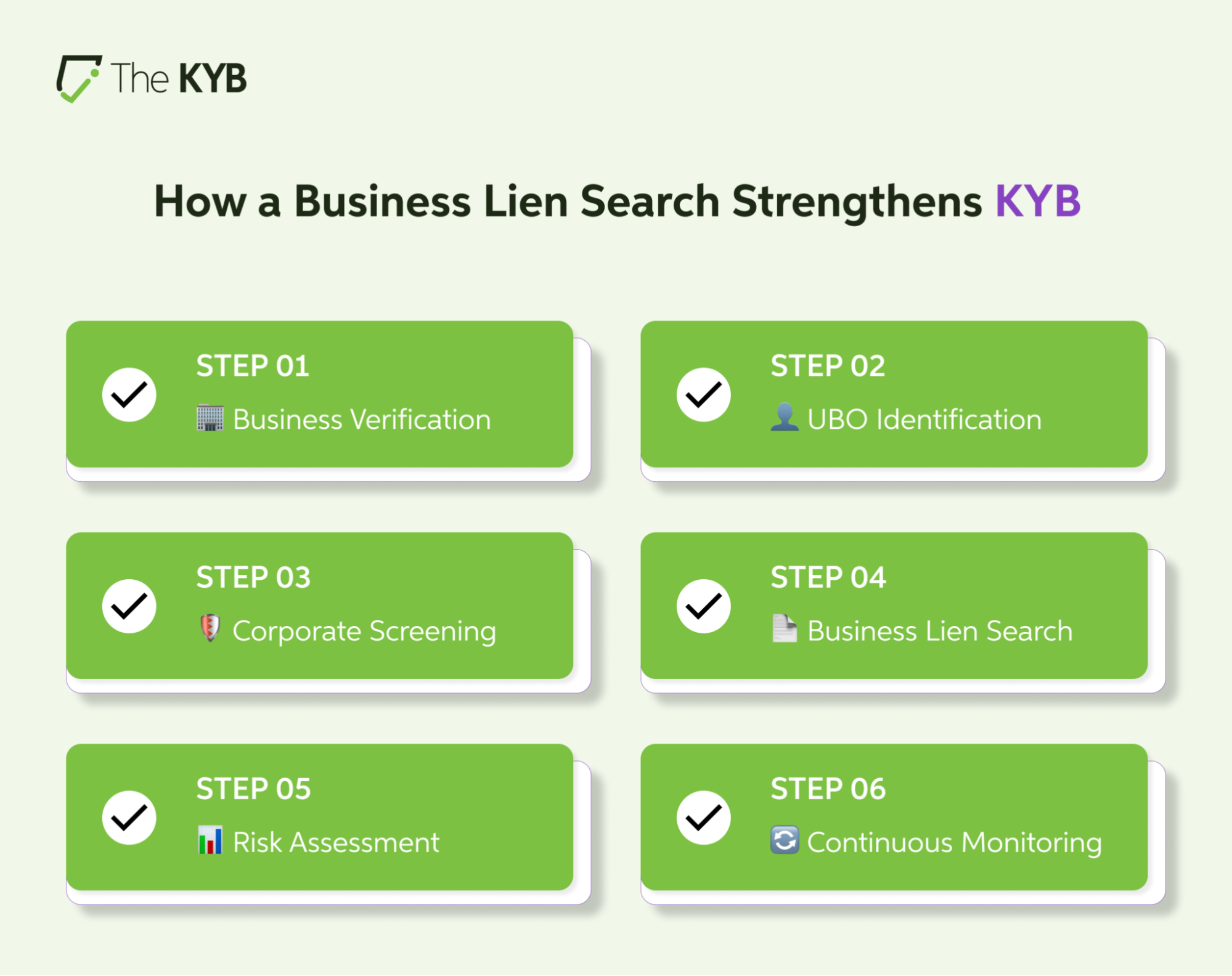
Today, however, effective KYB frameworks incorporate multiple layers of risk assessment. A comprehensive KYB process often includes:
-
Business Information Collection
Organizations gather foundational company information from official sources and corporate registries.
-
Business Verification
Verification procedures confirm legal existence, registration status, and operational legitimacy.
-
UBO Identification
Businesses identify Ultimate Beneficial Owners to improve transparency and understand ownership structures.
-
Corporate Screening
Organizations screen companies and associated individuals against sanctions lists, watchlists, politically exposed person databases, and adverse media sources.
-
Risk Assessment
Risk assessments evaluate various factors that may affect the organization’s exposure to financial crime, fraud, or compliance issues.
-
Business Lien Intelligence
Business lien searches provide additional visibility into financial obligations and asset-related claims.
Together, these components create a more complete picture of business risk.
Why Continuous Monitoring Matters
Business risk is not a constant. Rather, it changes and evoles with time along with companies’ development, restructuring, market expansion, or financial difficulty.
This can often lead to outdated information being gathered during the onboarding process.
For instance, a company with low risk verified at the start might find itself involved in legal conflicts, tax problems, ownership changes, or new financing in the future. These changes can have a profound impact on the company’s risk profile.
As a result, organizations are implementing continuous monitoring programs, not just relying on one-time verification checks.
This constant oversight can help businesses recognize relevant changes as they occur and take appropriate action to address new risks.
Moreover, continuous monitoring helps to enhance compliance programs and better inform business decisions along the relationship lifecycle.
Building a More Complete Company Verification Process
Effective company verification requires more than confirming legal existence.
Organizations seeking a broader understanding of business risk should consider a structured approach that includes:
- Verifying business registration and legal status
- Retrieving and reviewing company documents
- Identifying Ultimate Beneficial Owners
- Conducting corporate screening checks
- Performing business lien searches
- Assessing overall business risk
- Monitoring for ongoing changes and emerging risks
By combining these steps, organizations can develop a more comprehensive understanding of the companies they engage with.
Rather than viewing company verification as a single event, businesses can treat it as an ongoing risk management process.
Strengthen Company Verification with The KYB
A company verification search may not show financial commitments, which a business lien search can. Registration records establish a company’s existence but may not reveal claims of creditors, encumbrances on assets, complexity of ownership, or new business risks.
Today, business relationships are becoming increasingly complex, and as a result, there is a need for a more comprehensive method of doing due diligence. There has to be more to effective verification than just confirming the incorporation information.
It also means understanding the owners of the business, how vulnerable it is to risk and what might influence the longevity of the relationship.
The KYB helps organizations to create a more comprehensive view of the companies they deal with. Business verification, document retrieval, UBO identification, corporate screening, risk assessment, and continuous monitoring enable organizations to better assess business relationships with confidence and transparency.
Businesses can get the information they need to verify the companies they work with, understand risk, and make onboarding decisions throughout their business lifecycle, without having to rely on isolated checks from various sources.
Learn how The KYB is used to verify businesses, evaluate risk and enhance due diligence throughout the business relationship.