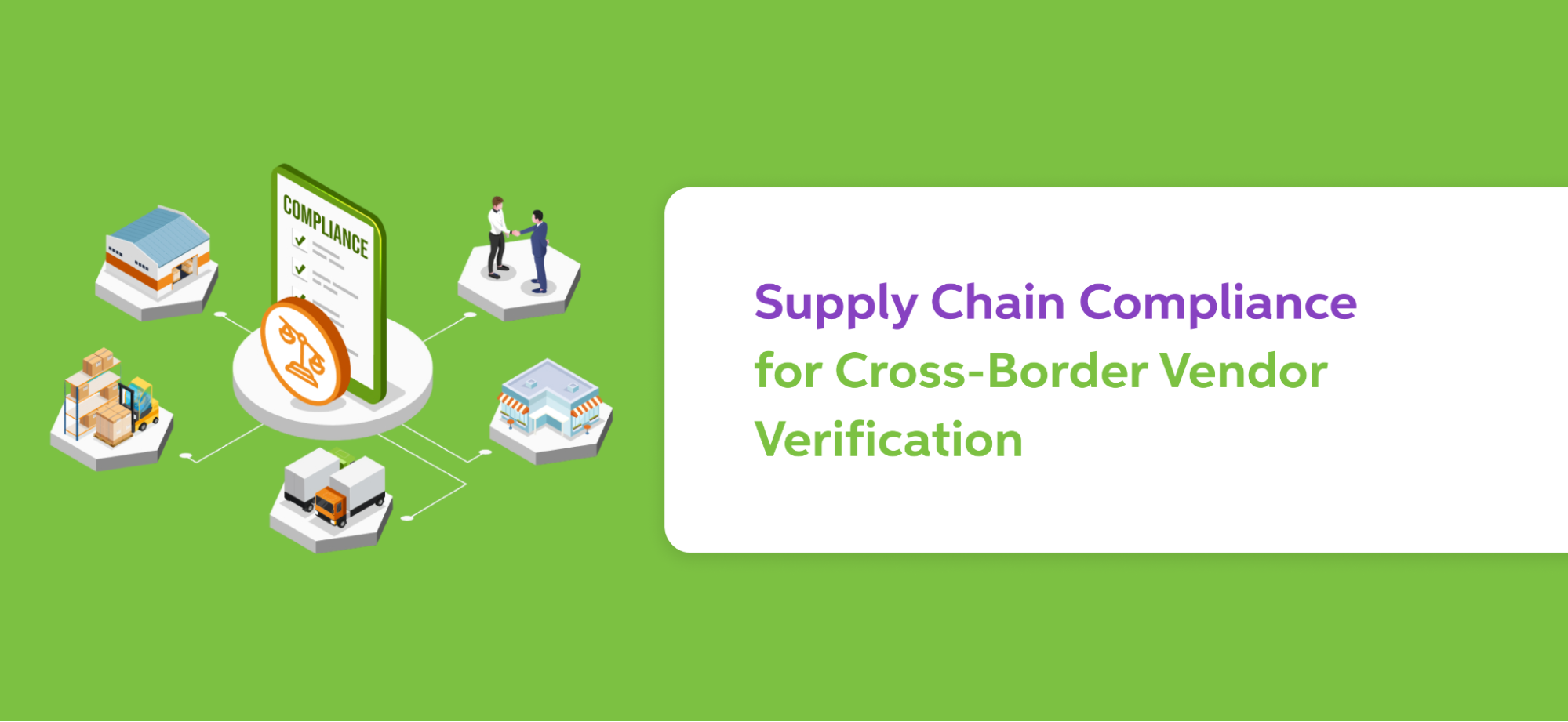
A supplier rarely works alone. One vendor could have a manufacturer, freight forwarder, customs broker, subcontractor, payment beneficiary, and parent company behind the scenes. Regulatory, financial, and reputational risk can be brought by either party.
This is why supply chain compliance does not end with the business named on the contract. Organizations must be aware of the wider network of production, distribution, billing, and payment for products and services.
The complex issue is determining which parties need checking, to what extent, and which checks may vary in each jurisdiction.
What Supply Chain Compliance Actually Covers
Supply chain compliance is the set of measures businesses implement to ensure suppliers and related counterparties comply with legal, regulatory, and internal standards.
These requirements may involve:
- Business registration and licensing
- Sanctions and watchlist restrictions
- Anti-bribery and corruption controls
- Export and trade restrictions
- Forced labor and modern slavery obligations
- Beneficial ownership transparency
- Environmental and human rights standards
- Tax and financial standing
Strong compliance in supply chain management covers more than the direct vendor. It may also extend to manufacturers, subcontractors, agents, distributors, logistics providers, and payment recipients.
The purpose is not to investigate every company equally. It is to identify where risk sits within the relationship and apply proportionate due diligence.
Why Jurisdiction Changes the Verification Standard
Information from companies is not readily accessible, making cross-border verification more challenging.
Some jurisdictions offer comprehensive information on directors, shareholders, company status, and filing history. Others provide only partial information or require access from within their local regions.
There might also be variations in beneficial ownership rules. Some jurisdictions may request information on the “natural person” owner; others only the immediate legal owner. Voting rights, agreements, or indirect ownership may also serve as bases for control.
Names create further complications.
A company can trade using a local name, an English translation, and a trading name. Different spellings or transliterations of the directors and shareholders may be listed on different databases.
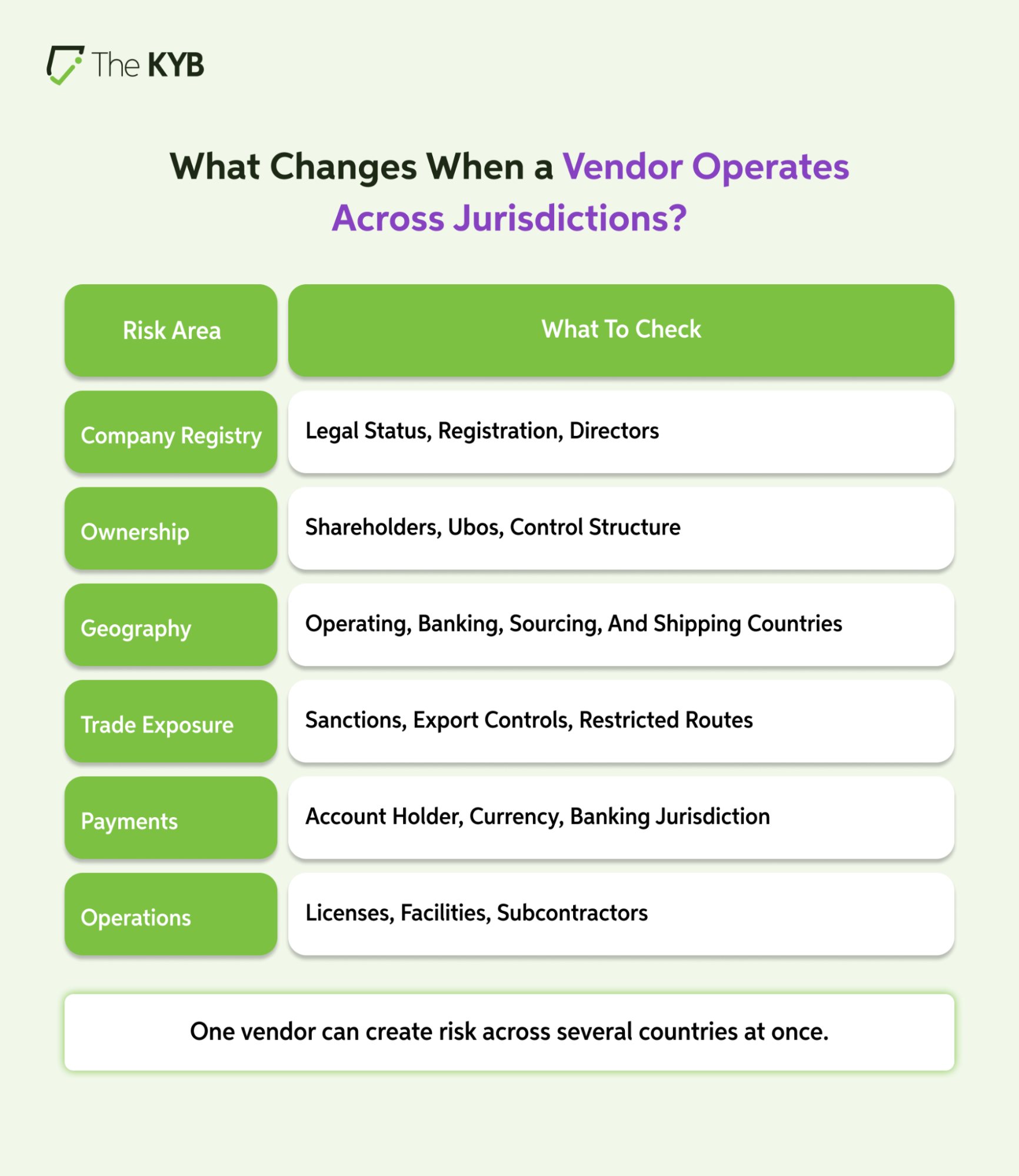
Effective supply chain regulatory compliance must therefore consider more than the country of incorporation of the vendor. The business should also look at the origin of the goods, the destination of the payment, the country the goods pass through, and the final customer.
Which Entities Should Be Verified?
Here is the list of parties that require KYB verification before getting into any business deal:
-
Direct Suppliers
It is important to verify the legal identity, operational status, ownership, licensing, and declared activity of the direct supplier.
The information on its registration should be the same as it was during onboarding. If there are discrepancies in the company name, address, registration number, or legal status, this must be investigated.
-
Manufacturers and Subcontractors
The company selling the product may not be the same as the one that produces it.
Businesses need to identify manufacturers and subcontractors that offer real exposure to regulation or operation. This is particularly the case for industries linked to forced labor, environmental issues, controlled goods, or high-risk geographical areas.
Effective undisclosed outsourcing can also undermine the quality of the original due diligence, as the approved vendor may not have a solid grasp of the actual product manufacturing process.
-
Agents and Intermediaries
Sales agents, customs brokers, distributors, and local representatives may act on behalf of the supplier or buyer.
These relationships can create bribery, corruption, sanctions, and payment risks, particularly when commissions are unusually high or the agent’s role is unclear.
Businesses should verify why the intermediary is involved, what services it provides, and how it is compensated.
-
Logistics and Shipping Partners
Freight forwarders, carriers, vessels, warehouses, and ports can create trade-compliance exposure. A legitimate supplier may still use restricted routes, sanctioned transport providers, or high-risk transshipment locations.
Logistics verification should focus on the parties handling the goods and whether the shipping route makes commercial sense.
-
Payment Counterparties
The business issuing the invoice should generally align with the company receiving payment.
Requests to pay an unrelated third party, a personal account, or a bank in an unrelated jurisdiction should trigger additional review.
The payment beneficiary is part of the commercial relationship and should not be treated as a separate finance-only detail.
How Far Down the Supply Chain Should Due Diligence Go?
Verifying every entity in a global supply network is rarely practical. Businesses need a risk-based boundary that determines when deeper checks are required. Factors that may justify extended due diligence include:
- High-risk sourcing or banking jurisdictions
- Complex or opaque ownership
- Restricted or dual-use products
- Significant reliance on subcontractors
- Unusual payment routes
- Government exposure
- High transaction values
- Critical supplier dependency
- Weak corporate disclosure
A low-risk office supplier may require standard verification. A manufacturer sourcing raw materials from several high-risk regions may require checks beyond the first tier.
The level of due diligence should reflect the potential impact of the relationship, not simply the size of the vendor.
Build a Jurisdiction-Based Verification Matrix
A verification matrix helps businesses apply consistent controls across different supplier relationships.
-
Map the Relationship
Identify every party involved in production, delivery, invoicing, payment, and ownership. This creates visibility into the full commercial chain rather than a single vendor record.
-
Match Each Party to Its Jurisdiction
Record the country of incorporation, operating location, manufacturing location, banking jurisdiction, and shipping route. A company registered in one country may operate and receive payments elsewhere.
-
Assign the Required Checks
The checks may include:
- Corporate registry verification
- Director and shareholder identification
- Ultimate beneficial ownership checks
- Sanctions and watchlist screening
- Adverse media review
- Licence verification
- Insolvency checks
- Trade restriction assessment
The depth of review should increase when reliable data is limited or the risk profile is higher.
-
Define Escalation Conditions
Clear escalation rules prevent inconsistent decisions. Examples include missing registry information, undisclosed owners, conflicting documents, unrelated payment beneficiaries, unexpected subcontractors, and sanctions-adjacent ownership structures.
Red Flags Basic Vendor Onboarding May Miss
Traditional onboarding can confirm that a business exists while overlooking how the wider relationship operates. Common warning signs include:
- The vendor and manufacturer are unrelated entities
- Payments are requested in a third jurisdiction
- The invoice issuer differs from the contract party
- The supplier refuses to disclose subcontractors
- Its registered activity does not match the goods supplied
- A newly formed company receives a major contract
- Ownership changes shortly before a transaction
- Goods follow an unnecessarily complex shipping route
- Different documents use inconsistent company names
One red flag may have a legitimate explanation. Several connected inconsistencies require deeper review.
When Vendors Should Be Reverified
Verification should not end once the supplier is approved. A new review may be required when:
- Ownership or directors change
- A new subcontractor is introduced
- The sourcing country changes
- Payment instructions are updated
- A new shipping route is used
- Order values increase materially
- The vendor enters a new product category
- A license expires
- Adverse media or enforcement action appears
- Regulations change in a relevant jurisdiction
Trigger-based reverification helps compliance teams focus on material changes instead of repeating the same checks on a fixed schedule.
The Role of Supply Chain Compliance Software
Manual checks are difficult for businesses with hundreds or thousands of counterparties. Company verification, ownership discovery, connected-party screening, risk scoring, and monitoring can all be part of a streamlined workflow with supply chain compliance software.
An effective platform should support:
- Entity relationship mapping
- Jurisdiction-specific verification
- Business and individual screening
- Risk-based approval workflows
- Trigger-based reverification
- Centralized supporting evidence
- Ownership structure visualization
- Audit-ready decision records
Technology does not replace compliance judgement. It improves the quality and consistency of the information behind each decision.
How The KYB Supports Cross-Jurisdiction Verification
The KYB assists organizations in verifying businesses and their counterparties worldwide.
It serves as a means for compliance teams to verify legal entity details, explore directors and shareholders, uncover UBOs, visualize ownership structures, screen for related parties, and track for changes upon onboarding.
The solution helps in reducing time spent on manual verification, improves supplier efficiency, and enables procurement. Additionally, the platform is best for compliance, finance, and legal teams to operate from a single supplier record.
This simplifies the identification of unknown relationships, the escalation of high-risk cases, and the creation of audit trails throughout the vendor lifecycle.
Verify businesses, uncover ownership, and strengthen supply chain compliance with The KYB.