
Beneficial ownership verification is becoming more than identifying a shareholder who crosses a percentage threshold.
Under the EU AMLR, businesses will have to obtain a clear understanding of the ultimate beneficiaries or controllers of a legal entity, its ownership hierarchies, and whether there is any information that they will need to keep up to date.
The AMLR generally applies from 10 July 2027 and will strongly influence how businesses approach AML compliance, customer due diligence, verification of beneficial ownership, and continuous monitoring.
For KYB teams, this means registry information remains important, but verification increasingly requires looking beyond a single record. Here are seven changes businesses should prepare for.
Major 7 Changes About UBO Under AMLR
Let’s have a quick look at all points:
1. Ownership and Control Become Two Separate Questions
Under Article 51 of the AMLR, beneficial owners include natural persons who either hold a direct or indirect ownership interest or exercise direct or indirect control over a legal entity.
Control through other means must be assessed independently and in parallel with ownership.
This means identifying shareholders alone may not always identify everyone who ultimately controls a business.
A person could exercise significant influence through voting arrangements, appointment rights or other forms of control even when their direct shareholding appears limited. For compliance teams, the question becomes:
Who ultimately owns the company and who ultimately controls it? This makes UBO identification more than a shareholder lookup exercise.
The KYB helps by bringing together company, officer, and beneficial ownership information into a single verification, rather than relying on a single corporate record to learn more about the people and relationships behind a legal entity.
2. Indirect Ownership Requires More Structured Calculation
The familiar beneficial ownership threshold is not disappearing. Under Article 52 of the AMLR, ownership of 25% or more of shares, voting rights or another ownership interest generally constitutes an ownership interest for beneficial ownership purposes.
What becomes particularly important is how indirect ownership is calculated.
If ownership is transferred through a series of companies, percentages should be calculated down the line. It is necessary to take into account the interests owned by a natural person in several ways.
For instance, a person’s 60% ownership of Company B would mean they have a 30% indirect stake in Company A if Company B owns 50% of Company A.
In structures involving multiple holding companies, subsidiaries or jurisdictions, UBO verification becomes considerably harder.
How The KYB helps: The KYB helps teams access shareholder and company information and build a clearer view of ownership structures, reducing the manual work involved in tracing complex corporate relationships.
3. Lower Thresholds Could Apply to Higher Risk Companies
One misconception surrounding the EU AMLR is that the regulation introduces a universal 15% beneficial ownership threshold in 2027.
It does not. The general threshold remains 25%. However, Article 52 allows the European Commission to identify categories of corporate entities associated with higher money laundering or terrorist financing risks and introduce lower thresholds for those categories.
For compliance teams, the practical lesson is flexibility.
Due diligence checks should not be designed around one static ownership threshold. Businesses may need to adjust their verification processes depending on entity type, risk profile and future regulatory developments.
The KYB can support this risk based approach by bringing business verification, ownership data and risk information into a more consistent workflow.
4. Nominee Arrangements Receive Greater Attention
The person listed in a corporate record may not always be the person ultimately behind the company. AMLR addresses nominee arrangements specifically.
Under Article 66, nominee shareholders and nominee directors must maintain adequate, accurate and current information about the person who nominated them and that person’s beneficial owners.
Their nominee status and related information must also be disclosed to the legal entity and reported through the relevant registration process. For KYB teams, this introduces an important question:
Is the registered shareholder or director acting on behalf of someone else?
This makes deeper beneficial ownership verification essential where nominee arrangements or unusual control structures are identified.
How The KYB helps: By connecting shareholder, director and ownership information, The KYB can support investigations where the person shown in company records may not represent the true ownership or control relationship.
5. Beneficial Ownership Information Must Stay Current
Verification cannot stop at onboarding. Under Articles 62 and 63, legal entities must maintain adequate, accurate and up to date beneficial ownership information.
Relevant information must generally be obtained within 28 calendar days of the creation of the legal entity.
Changes must also be reflected without undue delay and generally within 28 calendar days, while beneficial ownership information must be reviewed at least annually.
This matters because corporate structures change.
Shareholders leave. New holding companies appear. Ownership percentages shift. Directors change, and control arrangements evolve.
That means a UBO verified during onboarding may not remain the correct UBO throughout the customer relationship.
How The KYB helps: The KYB helps compliance teams access current company and UBO information and perform ongoing due diligence checks as business relationships evolve.
6. Registry Discrepancies Cannot Simply Be Ignored
Central beneficial ownership registers remain important, but AMLR makes clear that registry information is not automatically the final answer.
Under Article 24, where an obliged entity identifies a discrepancy between central register data and information collected during customer due diligence, the discrepancy generally has to be reported without undue delay and within 14 calendar days of detection.
This changes how teams should think about registry data.
A register is a valuable source of beneficial ownership information, but it should support verification rather than replace it.
AMLD6, Directive (EU) 2024/1640, further strengthens beneficial ownership registers by requiring Member States to ensure the information they contain is adequate, accurate and current.
How The KYB helps: The KYB can help teams compare corporate and ownership information across the wider verification process, making inconsistencies easier to investigate before an onboarding or monitoring decision is made.
7. UBO Verification Becomes Part of Ongoing Monitoring
The EU AMLR also strengthens the connection between onboarding and ongoing due diligence.
AMLA, the EU Anti Money Laundering Authority, is developing guidance on ongoing monitoring under Article 26 of the AMLR.
The direction is clear. Obliged entities need to continuously monitor business relationships and keep customer information current.
For beneficial ownership, this matters because a new shareholder, ownership restructuring or change in control may materially affect the customer’s risk profile.
A UBO may also become exposed to sanctions, PEP or adverse media risks after onboarding.
This means UBO Verification should increasingly be treated as an ongoing process rather than a one time check.
How The KYB helps: The KYB combines business verification, UBO identification, and risk screening to help teams maintain a clearer picture of both the company and the individuals behind it throughout the relationship.
What AMLR Changes for KYB Teams
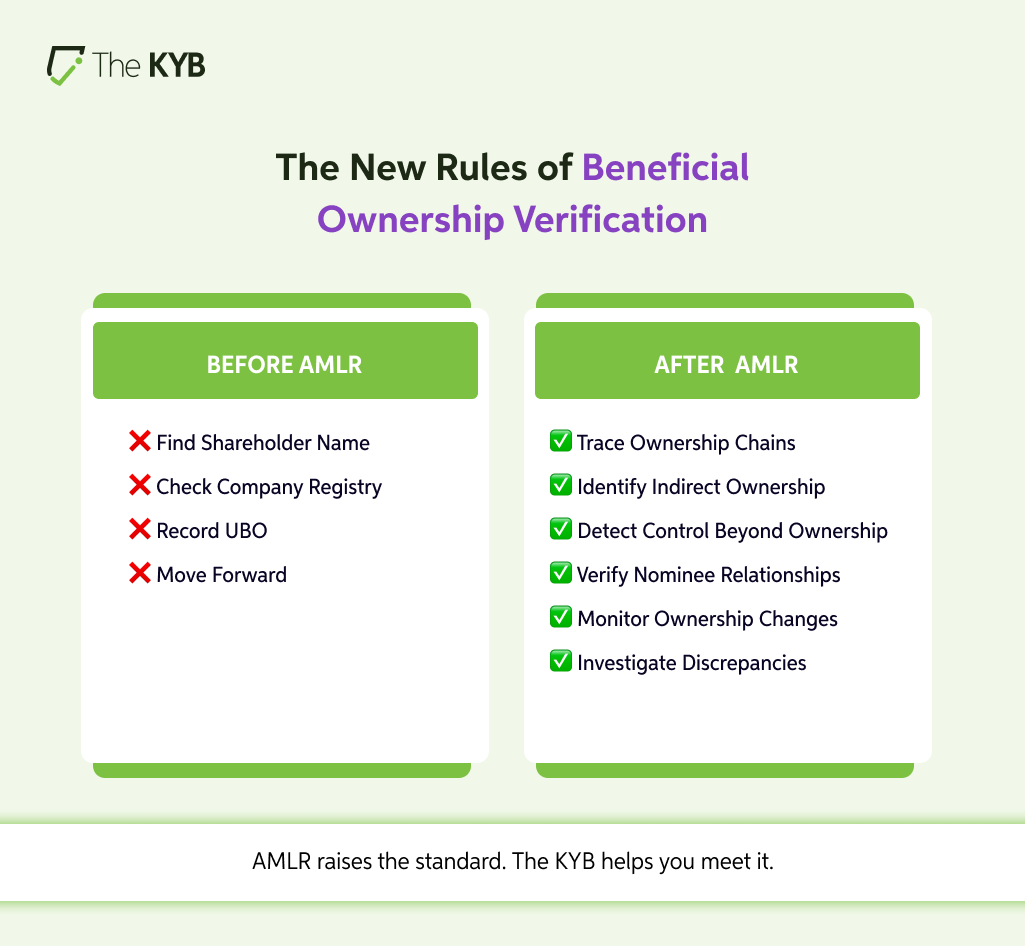
AMLR moves beneficial ownership verification closer to a process of understanding and evidencing ownership, rather than simply recording a UBO name.
Compliance teams increasingly need to:
- trace direct and indirect ownership
- assess control through other means
- recognise nominee arrangements
- investigate discrepancies
- keep beneficial ownership information current
- perform risk based due diligence checks
- maintain stronger AML compliance processes
These requirements become difficult to scale when company searches, ownership analysis and risk screening take place across separate systems.
The KYB brings business verification, UBO identification, verification, and risk screening into a connected workflow, helping compliance teams understand the companies they onboard and the individuals ultimately behind them.
With 10 July 2027 approaching, the priority should not simply be collecting more ownership data. It should be making beneficial ownership clearer, traceable and easier to verify.
Verify the business. Understand who is behind it. Prepare for AMLR with The KYB.