
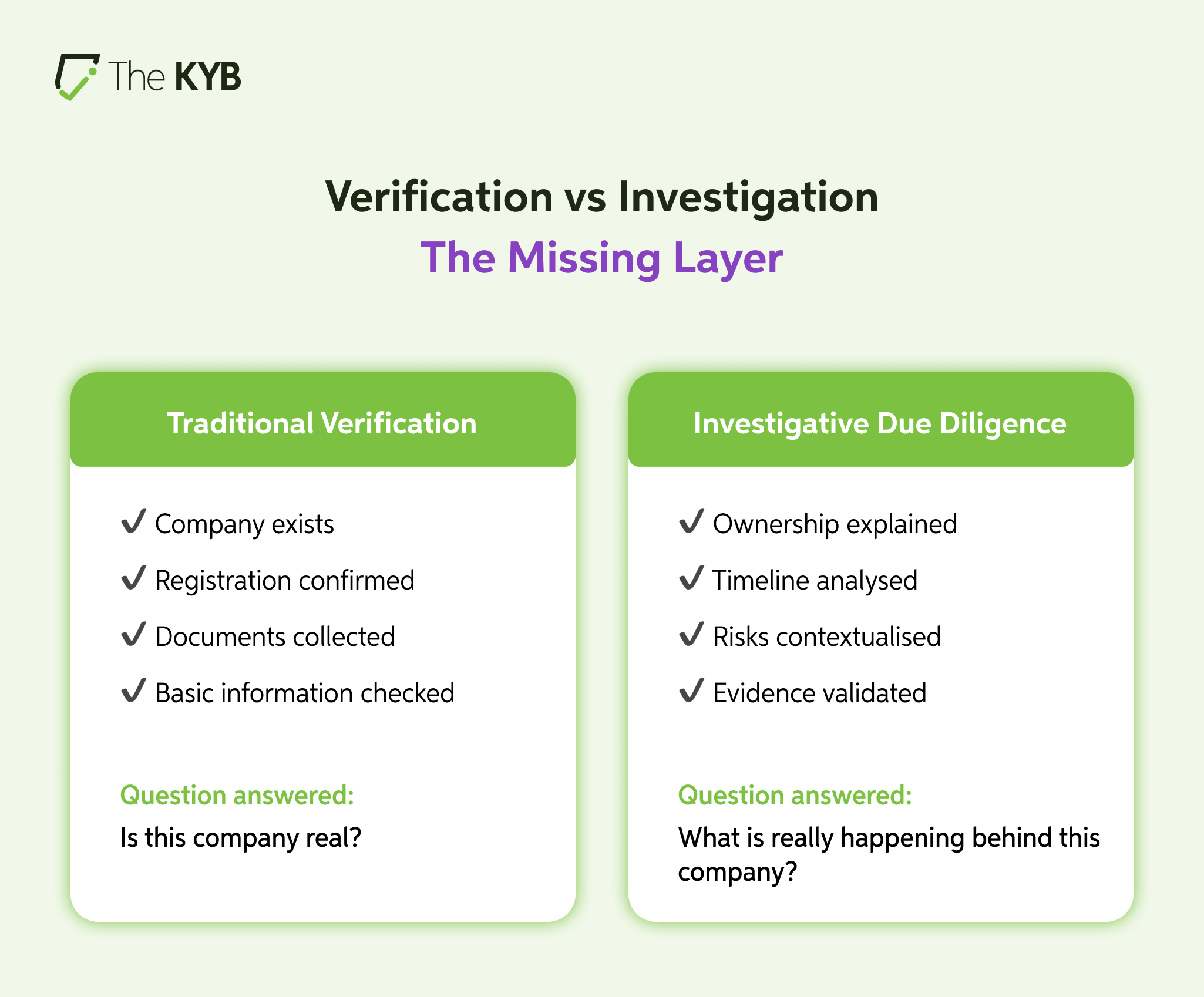
Do you know that it’s possible for a company to pass basic verification and still leave key questions unanswered?
It could be registered. The documents it produces can be uniform. Its directors and key shareholders may be in the right places. But there may still be aspects to the business that don’t make sense or connections that don’t fit together in the broader picture.
That’s where investigative due diligence plays an important role. Investigative due diligence isn’t just an extension of Know Your Business verification. It brings teams from fact-checking to testing the story behind the facts.
The goal is to determine whether there is evidence of a relationship and whether important things are being hidden.
For high-risk onboarding, investments, complex third parties and unusual corporate structures, these eight questions can help determine whether a business deserves approval, escalation or deeper investigation.
1. Does the Company’s Story Match Independent Evidence?
A business application gives you one version of the company. Investigative due diligence tests that version against independent evidence.
The question is not only whether the registration number is valid. Investigators should determine whether the company’s stated activities, operating history, location, ownership and commercial purpose make sense when compared with authoritative records and reliable external sources.
For example, a newly incorporated entity claiming years of operating history would require explanation.
Verification confirms individual data points. Investigation asks whether those data points form a believable whole.
An investigative due diligence platform can help to speed up this process by consolidating registry data, ownership information and risk intelligence into a single workflow.
2. Why Is the Ownership Structure Built This Way?
It is important to be aware of complex ownership, but it is not always a red flag. A subsidiary or a holding company may be established by groups for sound reasons.
Investigative due diligence asks a different question: why does this specific structure exist?
If control passes through several entities or jurisdictions, investigators should understand the commercial rationale rather than simply map the ownership chain. Unnecessary complexity can make it harder to identify who benefits from the company or who exercises meaningful control.
This moves the investigation beyond UBO identification. Knowing the ultimate owner is one answer. Understanding whether the path to that owner makes commercial sense is another.
That difference is important because investigative due diligence should go beyond just stating that they are related to the company and explain the relationship.
3. Is Anyone Influencing the Business Without Appearing Prominently in the Records?
Formal ownership does not always tell the complete story. There is always something unknown, such as a person who may influence a business through voting arrangements, financing, or control over connected companies without appearing as the largest shareholder.
Investigative due diligence should therefore examine the people surrounding the entity, not only those occupying obvious positions in corporate records.
The goal is to find out if there is a discrepancy between the apparent ownership and management and the actual decision-making.
For The KYB, company records, key-person data, ownership relationships and AML risk information can help surface parties that require closer human analysis instead of treating every name as an isolated result.
The KYB’s business due diligence offering combines verified company information, key-person identification, ownership analysis and sanctions and PEP screening.
4. Do Connected Companies Reveal a Pattern?
One company rarely exists in isolation.
Directors may hold positions in other entities. Shared owners or addresses can also connect companies that look unrelated at the start
Investigative due diligence looks at these relationships as a network.
A single dissolved company in a director’s history may be unremarkable. A repeated pattern of short-lived entities, shared addresses and frequent director changes may deserve more attention.
Connections are not proof of misconduct; rather, their value comes from revealing patterns that seem hidden when each company is reviewed in isolation.
Structured corporate data can help an investigative due diligence service identify these relationships quickly before analysts decide which connections justify deeper research.
That changes the investigation from a search for isolated red flags into an examination of how businesses and people connect.
5. Does the Timeline Make Sense?
Dates are one of the simplest investigative tools and one of the easiest to overlook.
The investigators should create a chronology of events surrounding the incorporation, director appointments, shareholder changes, ownership transfers, and any major regulatory actions.
Then they should ask whether the sequence makes sense.
Did ownership change immediately before a transaction? Did a business change its name or control shortly before seeking a new financial relationship?
None of these events automatically indicate wrongdoing. But chronology can transform apparently unrelated facts into a meaningful investigative lead.
Investigative due diligence asks not only “what happened?” but also “what happened just before and after it?”
That chronological view can reveal patterns that would remain invisible when company information is assessed as a static snapshot.
6. Can Negative Information Be Corroborated?
Finding negative information is easy. Deciding what it means is harder.
An article, allegation or regulatory mention should not automatically become a final risk conclusion. Investigators need to establish whether it relates to the correct entity and whether independent evidence supports it.
They should also distinguish between an allegation, an investigation, an enforcement action and a proven offence.
This is a key difference between screening and investigative due diligence.
Screening surfaces potential risk. Investigation determines whether that risk is relevant and material.
Good investigative due diligence providers should therefore offer more than database hits. They should help organisations reach defensible conclusions from the information discovered.
This is particularly important when similar company names, outdated reports or incomplete information could otherwise result in the wrong business being associated with a negative event.
7. What Information Is Missing and Why?
Sometimes the strongest signal is not what appears in the records. It is what does not.
Missing ownership information, unexplained gaps in corporate history, inconsistent addresses or unavailable supporting evidence can create uncertainty.
Investigators should identify those gaps explicitly.
Can the information be obtained elsewhere? Is the gap normal for that jurisdiction? Has the company provided a reasonable explanation?
The objective is not perfect knowledge. It is sufficient evidence to make a proportionate and defensible decision.
This prevents investigative due diligence from becoming an endless exercise in collecting more information. Investigators instead focus on which unanswered questions materially affect the risk assessment.
An unexplained gap should therefore become a defined investigation point rather than disappear inside a large volume of otherwise valid business data.
8. Is There Enough Evidence to Approve, Escalate or Exit?
The end goal of every investigation should be a decision, not a list of search results.
This can be to approve the relationship, request further information, implement increased monitoring, escalate for specialist review or reject the relationship.
The report should be an investigative due diligence report that demonstrates what has been checked, what information has been found, what remains undetermined, and why each is important.
This is where an investigative due diligence platform and human expertise work best together.
Technology can organise evidence and surface relationships at scale. Analysts can determine context, materiality and the appropriate response.
The point of investigative due diligence is therefore not to find as many red flags as possible. It is to produce enough reliable intelligence to support a decision that can be explained and defended.
Investigative Due Diligence Service or Platform: Which Approach Fits?
The answer depends on the case.
For complex cases involving litigation research, asset tracing, source enquiries, local intelligence, or allegations that require significant human investigation, a specialist investigative due diligence service may be required.
A due diligence investigation platform would be more suitable for efficiency, repeatability, and corporate intelligence gathering.
It can help teams collect company information, identify who owns it, exclude related parties, and build a body of evidence before they begin a lengthy, manual process.
When looking at a due diligence service provider for their organisation, there are more than just the number of databases to take into account. They should consider authoritative sources, ownership relationships, cross-border research, audit trails and access to expert review.
The best model is typically the one that automates the reliable, verifiable aspects and escalates the aspects that require a decision.
This technique also prevents highly skilled investigators from spending their time manually collecting information that technology can retrieve and structure more effectively.
Make Investigative Due Diligence More Actionable With The KYB
Investigative due diligence should answer more than “Is this company registered?”
It is supposed to help a business understand whether the entity’s story is clear, who really influences it, what its corporate relationships reveal and whether the available evidence supports moving forward.
The KYB helps compliance teams build that evidence base through business verification, ownership intelligence, key-person identification, AML screening and deeper due diligence review. Its Business Due Diligence service combines official registry research with expert verification, company structure analysis and screening of key individuals.
Rather than forcing analysts to begin every investigation by manually searching fragmented sources, The KYB provides a well-structured foundation for determining where deeper investigation is required.
The outcome is not only more data, but a clearer route from business information to an informed risk decision.