

Compliance Is Not About Doing More Checks. It Is About Doing the Right Checks.
The challenge for compliance teams today is balancing robust risk control with a better, faster and smoother onboarding experience.
There are still many organisations that continue to take a one size fits all solution, equating the same level of verification for all business relationships. Though this might seem comprehensive, it can lead to delays, added compliance burden and expense, and the loss of compliance resources.
Businesses with complex ownership or unclear beneficial ownership and those engaging in higher-risk activities do not necessarily have to undergo the same verification process as transparent businesses with clear ownership.
This is where simplified due diligence comes in. But what is simplified due diligence and how does it work?
What Is Simplified Due Diligence? Definition and Purpose
The simplified definition of due diligence applies to compliance strategies in which businesses use less or modified verification procedures for relationships deemed to be less risky.
Conventional due diligence includes extensive information gathering, verification of ownership, risk assessment and continuous monitoring.
All these steps are important, but not always feasible when it comes to every business relationship.
Simplified due diligence allows organisations to adjust their approach based on factors such as:
- Business type
- Ownership transparency
- Geographic exposure
- Industry activity
- Regulatory status
The purpose of simplified due diligence is not to weaken compliance controls. It is to make them more efficient and proportional.
A common misconception is that simplified means “less compliance.” In reality, businesses still need enough information to understand who they are dealing with and why a lower level of verification is appropriate. Simplified due diligence focuses on:
- Applying proportionate checks
- Reducing unnecessary verification steps
- Prioritising higher-risk relationships
- Maintaining evidence behind risk decisions
The approach shifts compliance from a volume-based process to a risk-focused one.
Why Businesses Need a Risk-Based Approach to Due Diligence
Traditional compliance models often treat every business relationship equally. This means a publicly listed company with transparent ownership and a privately held company with complicated ownership structures may experience similar onboarding requirements. This creates two major challenges.
-
Compliance Teams Spend Time Where Risk is Low
Manual reviews, repeated document requests, and unnecessary verification steps can slow down onboarding for businesses that present limited risk.
These delays affect customer experience and create additional workload for compliance teams.
-
Higher-Risk Relationships May Not Receive Enough Attention
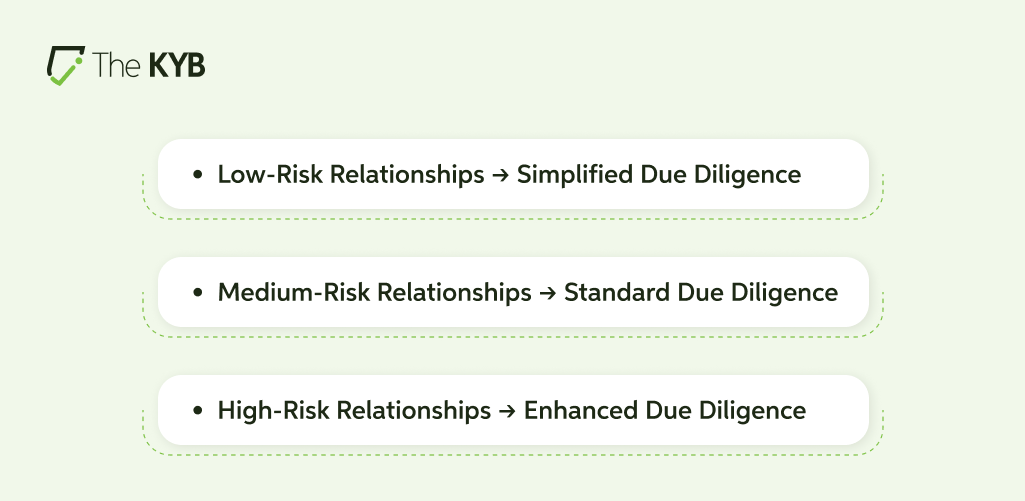
When resources are distributed equally across every relationship, compliance professionals may have less time to investigate businesses requiring deeper analysis. A risk-based approach changes this model. Instead of asking: “Do we perform the same checks on every business?”
Organisations should ask: “What level of verification does this relationship actually require?”
This creates a more balanced compliance framework:
Simplified Customer Due Diligence: When Less Can Be Enough
Simplified customer due diligence allows businesses to adjust their verification approach according to the risk profile of a relationship.
However, applying simplified measures requires careful evaluation. A business should not automatically be classified as low risk simply because it appears straightforward. Several factors should be considered.
-
Ownership Transparency
Ownership is one of the most important considerations in any KYB process. A company with clear ownership information and identifiable beneficial owners generally creates fewer risk concerns compared to an entity with:
- Multiple ownership layers
- Unclear control structures
- Hidden beneficial owners
Before applying simplified due diligence, businesses should understand who ultimately owns or controls the entity.
-
Regulatory Status
Some organisations may already operate under strict regulatory requirements. Examples include:
- Regulated financial institutions
- Publicly listed companies
- Government-related entities
Existing transparency requirements may influence the level of verification required.
-
Geographic Risk
Location can also influence risk assessment. Businesses should consider:
- Country of incorporation
- Operating jurisdictions
- Regulatory environment
- Exposure to higher-risk regions
Geography alone should not determine risk, but it remains an important factor when evaluating whether simplified measures are appropriate.
-
Business Activity
The nature of a company’s operations also matters. A clear business model with predictable activities may support simplified measures, while complex or unusual activities may require additional investigation.
Simplified Due Diligence Checklist: 7 Questions Before Applying SDD
Before applying simplified due diligence, businesses need a structured approach to determine whether reduced measures are justified. A practical simplified due diligence checklist includes:
1. Can We Verify the Business Identity?
Confirm:
- Legal business name
- Registration details
- Business status
- Official company information
A clear business identity creates the foundation for reliable risk decisions.
2. Is Ownership Clearly Identified?
Review:
- Shareholders
- Directors
- Beneficial owners
- Ownership structure
Unclear ownership may indicate that additional checks are required.
3. Does the Business Activity Match Its Profile?
Evaluate whether:
- The industry is understood
- Activities are legitimate
- The expected business purpose is clear
4. Are There Any Risk Indicators?
Look for warning signs such as:
- Negative media coverage
- Unusual ownership arrangements
- Regulatory concerns
- Inconsistent company information
5. Can the SDD Decision Be Explained?
Compliance teams should be able to demonstrate why simplified measures were appropriate. Maintaining evidence behind risk decisions helps organisations remain prepared for audits and regulatory reviews.
6. Are Monitoring Requirements Defined?
Simplified due diligence does not mean the relationship no longer requires oversight. Businesses should continue monitoring for important changes that may affect risk levels.
7. When Should Risk Be Reviewed Again?
Risk profiles can change due to:
- Ownership changes
- New directors
- Business expansion
- Regulatory updates
A low-risk relationship today may require a different approach in the future.
Simplified Due Diligence vs Standard Due Diligence
While both approaches aim to understand and manage risk, the difference lies in the depth and intensity of verification.
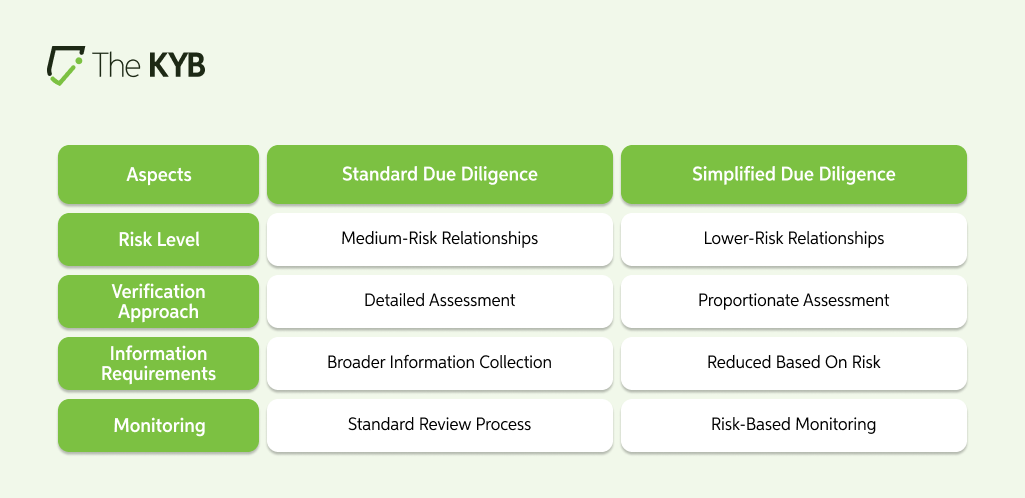
The key difference is not whether checks happen. It is how those checks are designed around risk.
Common Mistakes Businesses Make When Applying Simplified Due Diligence
-
Treating SDD as No Due Diligence
Don’t assume simplified means businesses can ignore verification. Organisations still need sufficient information to understand the entity and make compliance decisions.
-
Using Company Type Alone to Determine Risk
Not every industry or company category automatically means that it is suitable to use simplified measures. The elements of ownership, geographic location and business activity should also be taken into account.
-
Ignoring Beneficial Ownership Complexity
A registered company may appear legitimate while still having unclear control structures. Understanding beneficial ownership remains essential for accurate risk assessment.
-
Never Reviewing Risk Classification
Risk is not permanent. Changes in ownership, operations, or business activities can affect whether simplified measures remain appropriate.
Smarter Compliance Starts With Smarter Risk Decisions
With simplified due diligence, businesses can focus resources where they are most needed and avoid unnecessary verification procedures.
The goal isn’t to reduce controls, but to make informed compliance decisions based on a valid risk assessment.
This approach can help organisations deliver faster onboarding while ensuring confidence in business relationships by incorporating a risk-based approach and the business information they rely on.
By offering businesses access to verified business information, ownership insights, and simplified KYB workflows, The KYB helps in making informed decisions with greater clarity.
With the right information at the right time, compliance teams can apply simplified due diligence with confidence and stay ready for regulatory expectations. Book a demo or visit The KYB’s website today to learn more!