
Fraud detection has become faster. Fraud decisions have not necessarily become better.
Organisations now have access to transaction alerts, company records, sanctions data, adverse media, ownership information, behavioural analytics, and automated scoring. Yet having more signals does not automatically create an effective fraud risk management program.
The real challenge is connecting those signals to the correct business, understanding what they mean together, and turning them into a defensible decision.
The scale of the problem makes that distinction important. According to the ACFE Occupational Fraud 2024: A Report to the Nations, Certified Fraud Examiners estimate organisations lose 5% of revenue to fraud each year. The study examined 1,921 cases across 138 countries and territories, representing more than $3.1 billion in losses.
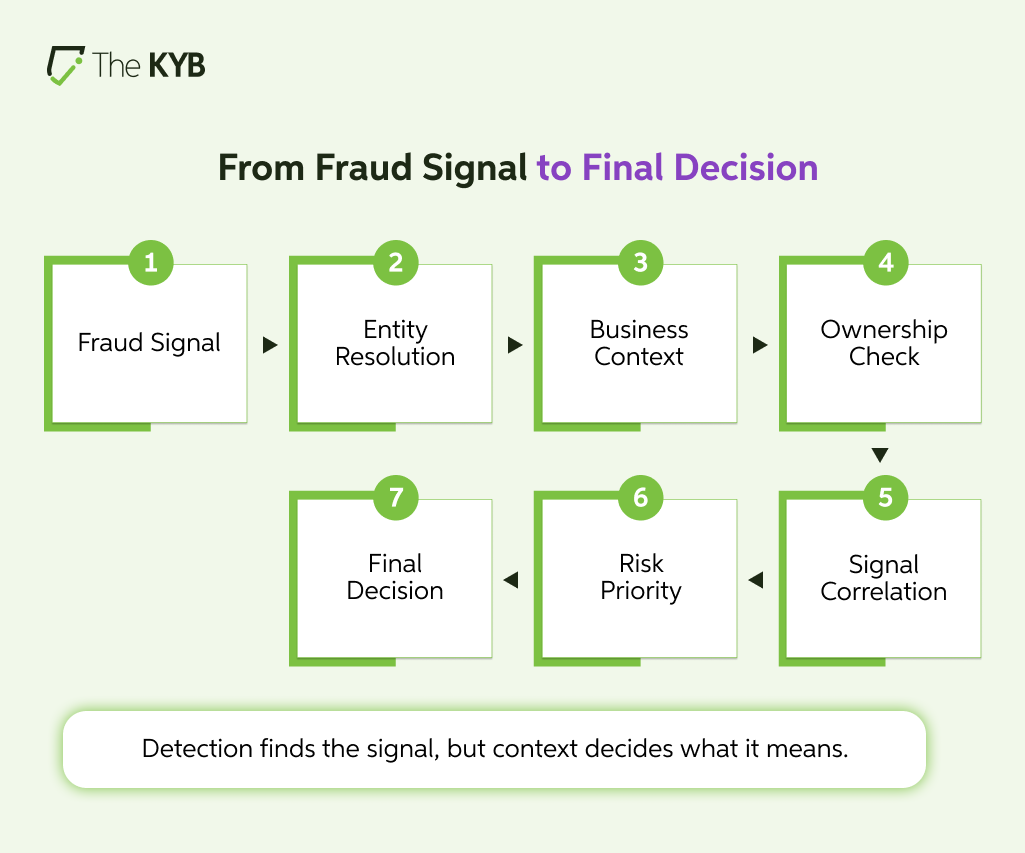
A modern fraud risk management strategy therefore needs to address more than detection. It needs to close the gaps between an alert appearing and an organisation understanding what action that alert actually requires.
Here are eight gaps enterprises should examine.
1. The Entity Resolution Gap
A fraud alert is only useful when it is attached to the correct entity.
Business names are rarely unique. Companies may operate under trading names, abbreviations, translated names, former names, or subsidiaries. Similar names across jurisdictions can also cause unrelated businesses to become mixed together.
If a fraud system cannot determine which legal entity is actually involved, subsequent screening and investigation may begin from the wrong starting point.
Effective enterprise fraud risk management should therefore connect risk information to identifiers such as registration numbers, jurisdiction, legal name, address, and company status.
This is different from simply asking whether a business exists. The more important question is: Which exact business does this fraud signal belong to?
Resolving that question early can help reduce unnecessary investigations and prevent material risk from being attributed to the wrong organisation.
2. The Context Gap
Fraud alerts rarely explain themselves. A large payment may be suspicious in one situation and completely normal in another. A newly incorporated company may deserve additional scrutiny in one industry while being routine in another.
This creates a context problem. Fraud risk management software can generate alerts based on rules or unusual activity, but analysts still need information about the business behind that activity.
Useful context may include:
- Business activity
- Legal structure
- Jurisdiction
- Company age
- Ownership
- Corporate relationships
- Regulatory exposure
The objective is not to turn every corporate characteristic into a fraud indicator. Instead, business information helps investigators interpret whether an alert fits the counterparty they are reviewing.
Good fraud detection finds anomalies. Good fraud risk management explains whether those anomalies matter.
3. The Ownership Attribution Gap
Fraud risk does not always sit directly on the company being investigated. A business itself may have no obvious negative record while a controlling person or beneficial owner presents material risk.
This makes ownership attribution particularly important when investigating corporate counterparties.
The Financial Action Task Force has strengthened its beneficial ownership standards by requiring access to adequate, accurate, and up-to-date information about the true owners of companies. FATF specifically highlights the misuse of anonymous corporate structures by criminals, corrupt actors, and sanctions evaders.
For fraud and risk management teams, the practical issue is therefore not simply whether ownership information has been collected.
It is whether risk associated with the people behind a company can be connected back to the business decision being made.
A beneficial owner, director, shareholder, and legal entity should not exist as unrelated records inside separate systems. The relationship between them is part of the risk.
4. The Signal Correlation Gap
One weak signal does not necessarily indicate fraud. Several individually minor signals appearing together can be far more important.
Consider a company that has:
- A recent ownership change.
- A director associated with several short-lived companies.
- A transaction involving an unexpected jurisdiction.
- A negative media report involving one of its controlling individuals.
Individually, each signal may have a reasonable explanation. Viewed together, they create a different risk picture.
A strong fraud risk management solution should therefore support correlation rather than treating every alert as an isolated event.
This is one of the key differences between collecting data and creating risk intelligence. The objective is not to generate more alerts. It is to understand relationships between the alerts already being generated.
5. The Workflow Fragmentation Gap
Fraud information often exists across too many systems.
A procurement team may hold vendor information. Compliance may operate screening tools. Finance may see payments. Onboarding may own business documentation. Fraud teams may operate transaction monitoring separately.
Each team can therefore possess one piece of the story while nobody sees the entire relationship.
This creates one of the most practical weaknesses in enterprise fraud risk management.
When evaluating fraud risk management services or technology, businesses should consider how information moves between existing systems.
An alert becomes much more useful when investigators can quickly access the corporate information required to evaluate it without repeatedly searching separate databases or requesting information from another department.
An effective architecture should bring relevant business intelligence closer to the point where the decision is made.
6. The Payment-to-Counterparty Gap
Payment fraud controls tend to focus on what happened during a transaction. That information is important, but it does not always explain who is behind the payment. For example, transaction monitoring may identify:
- Unexpected payment values
- Sudden changes in payment destinations
- Unusual transaction velocity
- Activity involving unfamiliar jurisdictions
But payment fraud risk management becomes more informative when these transaction signals can be evaluated alongside counterparty information.
- Does the beneficiary correspond to the business named in the contract?
- Does the jurisdiction make sense for the organisation?
- Has ownership changed recently?
- Is another legal entity unexpectedly receiving the funds?
The purpose is not to replace transaction monitoring with KYB. The two answer different questions. Transaction monitoring explains what is happening with the money.
Business intelligence helps explain who is behind the activity. Connecting the two can provide investigators with significantly stronger context.
7. The Alert Prioritisation Gap
More alerts can create less clarity. When fraud teams receive large volumes of alerts without sufficient prioritisation, analysts may spend significant time investigating cases that ultimately present little risk.
The issue is therefore not simply detecting more potential fraud. A mature fraud risk management strategy should help determine which cases deserve attention first.
That can involve combining factors such as:
- Severity of the fraud signal
- Business risk profile
- Ownership exposure
- Jurisdiction
- Screening findings
- Transaction characteristics
- Existing relationship history
A fraud risk management solution should make these factors easier to interpret together.
Automation can support prioritisation, but teams should still be able to understand why a particular case was elevated. A score without reasoning can create another black box rather than a better decision.
8. The Decision Evidence Gap
The final gap appears after the investigation.
- Why was a business approved?
- Why was another escalated?
- Which evidence supported the decision?
- What changed between two reviews?
Fraud investigations often involve judgment. That makes documentation essential.
A useful fraud risk management guide should therefore define how risk decisions are recorded, including the information reviewed, findings made, escalation performed, and final rationale.
This is especially important for larger enterprises where multiple analysts or departments may work on the same business relationship.
Decision evidence creates consistency. It also allows future investigators to understand previous conclusions instead of starting from zero whenever another alert appears.
The objective of risk management for fraud is not simply to produce an answer.
It is to produce an answer that can later be explained.
What Should Fraud Risk Management Software Actually Help Teams Do?
Organizations evaluating fraud risk management software, a managed service, or an internal solution should avoid measuring value purely by the number of data sources or alerts available.
Instead, ask whether the system helps teams move through four stages:
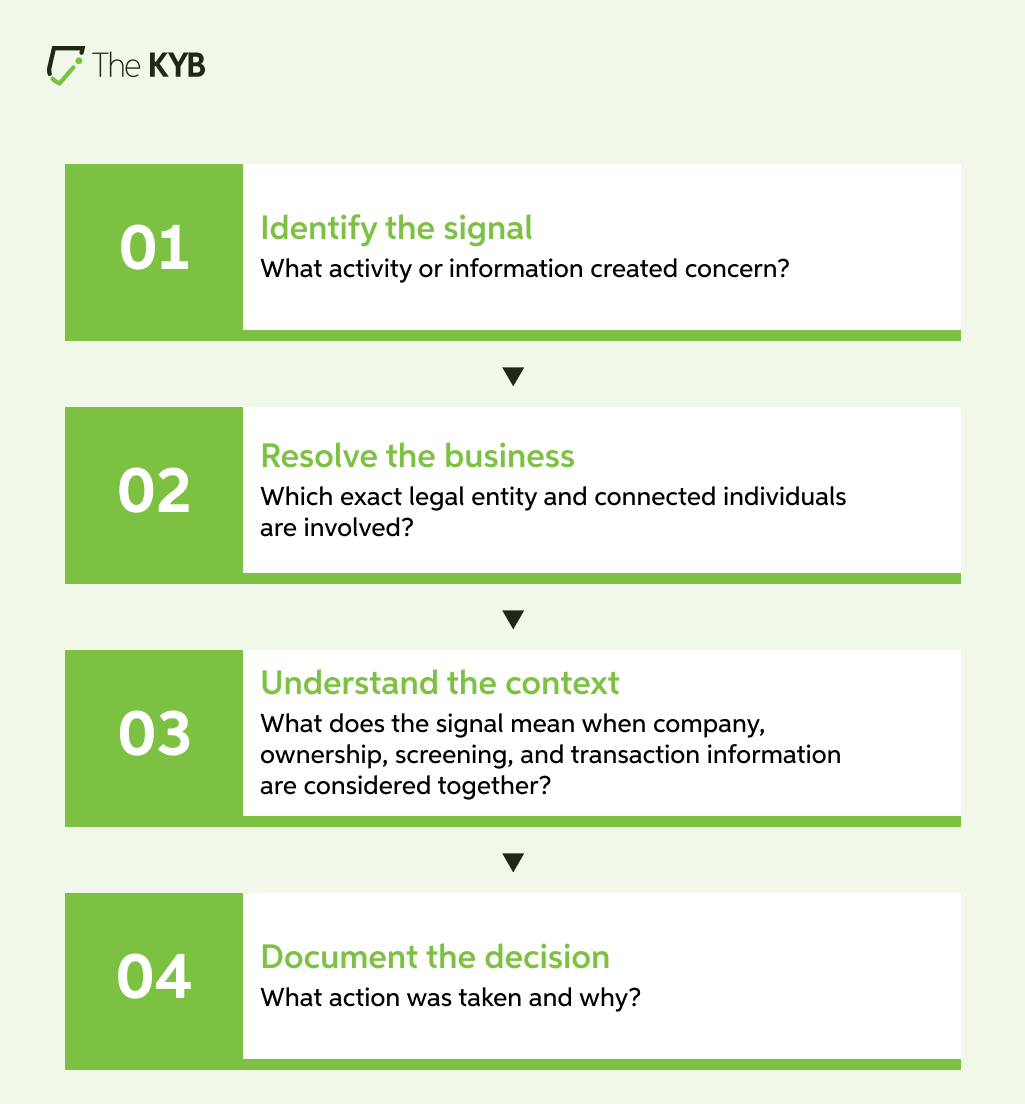
Identify the signal.
What activity or information created concern?
Resolve the business.
Which exact legal entity and connected individuals are involved?
Understand the context.
What does the signal mean when company, ownership, screening, and transaction information are considered together?
Document the decision.
What action was taken and why?
This model makes fraud risk management less about collecting isolated warnings and more about improving the quality of decisions.
Where The KYB Fits Into Fraud Risk Decisions
The KYB does not need to replace every component of an enterprise fraud stack. Its role can be more specific.
When a fraud alert involves a business counterparty, investigators need reliable context about the entity behind it.
The KYB helps organisations verify legal entities, access corporate registry information, identify beneficial owners, examine business relationships, and incorporate relevant risk intelligence into business due diligence.
That context can strengthen investigations occurring elsewhere across fraud, payments, procurement, onboarding, or compliance workflows.
Rather than treating KYB as another alert generator, enterprises can use corporate intelligence to answer a more valuable question:
What does this alert mean for this specific business relationship?
Closing the Distance Between Detection and Decision
The future of fraud risk management is unlikely to be defined by who generates the greatest number of alerts. Instead, it will be defined by who can interpret risk fastest and most accurately.
That requires closing the distance between fraud signals, legal entities, beneficial owners, transactions, corporate relationships, and the people making the final decision.
A strong fraud risk management solution therefore does not simply help organisations detect something unusual.
It helps them understand what happened, who is involved, how the signals connect, and what action should follow.
For enterprises working with thousands of customers, vendors, merchants, suppliers, or partners, that context can be the difference between detecting noise and identifying meaningful risk.
Turn fraud signals into informed business decisions with The KYB.