

A PEP is detected. Approve or reject? The answer should rarely depend on the PEP match alone.
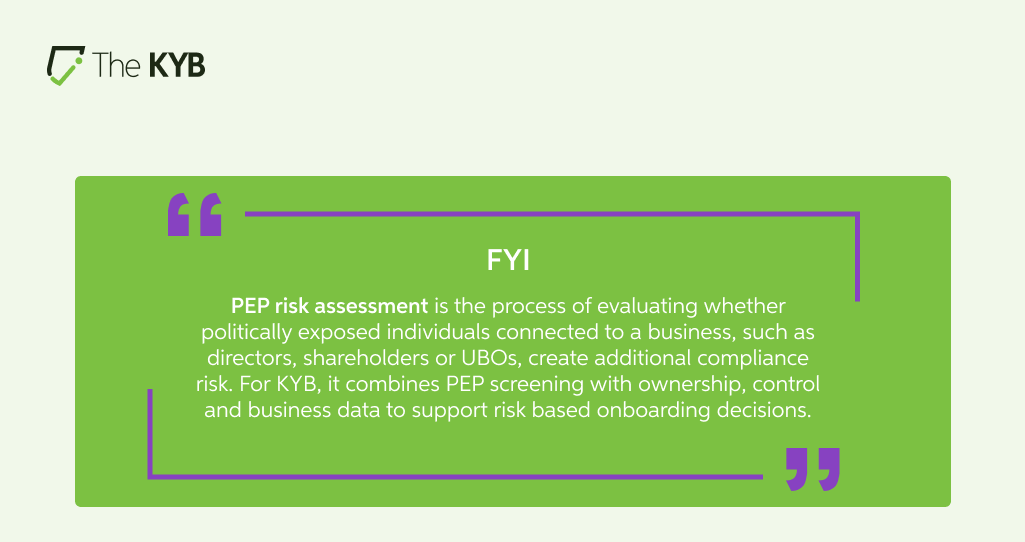
A PEP risk assessment evaluates the level of risk associated with a politically exposed person by looking at factors such as political influence, ownership and control, jurisdiction, source of wealth, business activity, adverse information and the nature of the business relationship.
PEP status itself is not evidence of wrongdoing. Instead, it signals that additional scrutiny may be required before a business relationship is approved.
For KYB teams, this becomes particularly important when PEP exposure sits behind a company through a director, shareholder or ultimate beneficial owner. A business may appear legitimate at entity level while deeper ownership checks reveal political exposure that changes its overall PEP risk profile.
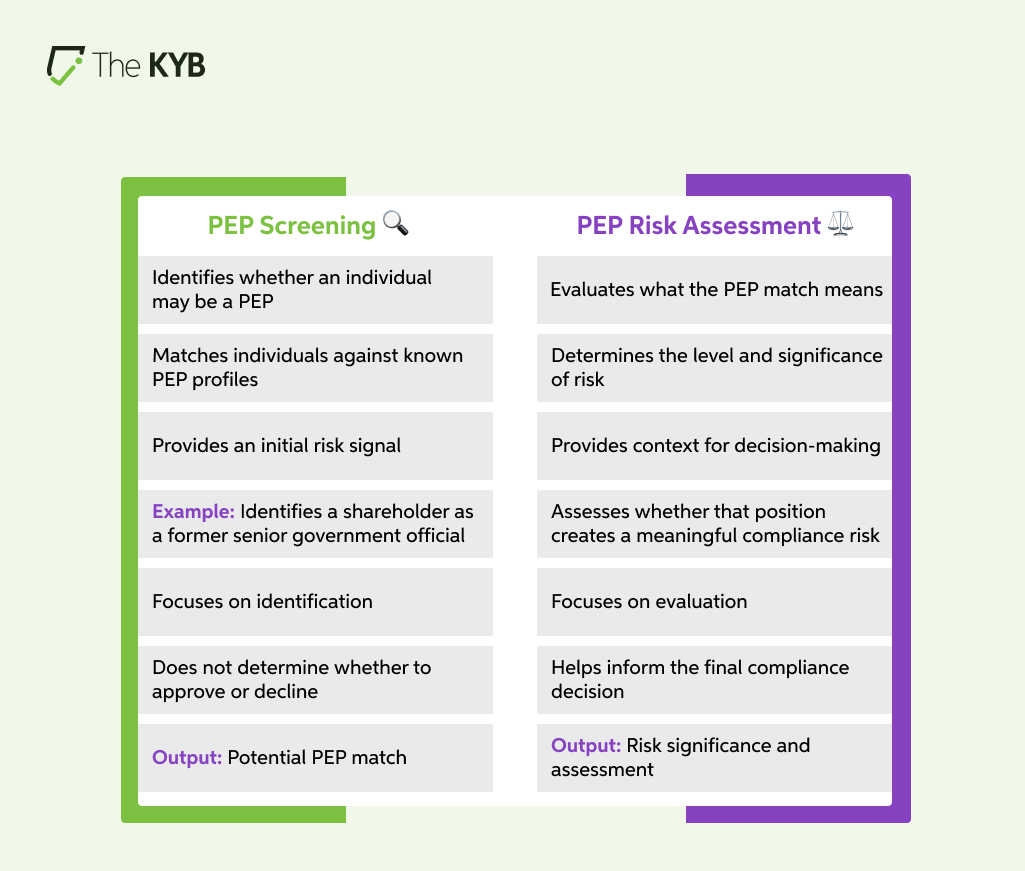
This is why PEP risk screening should be followed by contextual assessment. Compliance teams need to understand who the individual is, how they are connected to the company and whether that connection creates additional risk.
Why PEP Risk Assessment Matters in KYB
Know Your Business processes are designed to establish whether a company is legitimate and to understand the people behind it.
PEP exposure can emerge through a company director, shareholder, ultimate beneficial owner or another person exercising significant control. It may also appear indirectly through family members, close associates or layered corporate structures.
FATF guidance specifically extends PEP related considerations to family members and close associates, which makes understanding relationships and beneficial ownership particularly important.
A strong PEP risk management process therefore connects corporate verification with individual screening.
Instead of asking only, “Is this company registered?” compliance teams should also be able to answer:
- Who owns it?
- Who ultimately controls it?
- Are any connected individuals politically exposed?
- What does that exposure mean for this specific business relationship?
Answering these questions gives compliance teams more context before onboarding or approving a business.
PEP Screening vs PEP Risk Assessment
The following eight factors can help businesses make a more informed approval decision.
1. Nature and Seniority of the Political Position
Not every politically exposed role carries the same degree of influence.
Compliance teams should consider the seniority of the position and the authority associated with it. A role involving significant control over government budgets, public contracts, regulatory decisions or state owned enterprises may create different exposure than a position with limited decision making authority.
Relevant questions include:
- How senior is the individual’s position?
- Do they control or influence public funds?
- Can they influence licences, contracts or procurement decisions?
- Do they maintain significant political influence despite leaving office?
FATF guidance also recommends a risk based approach when dealing with former PEPs rather than relying solely on fixed time limits. Factors can include the seniority of the previous position and whether the individual continues to exercise influence.
2. Type of PEP Exposure
Compliance teams should establish the nature of the political exposure. This may involve a foreign PEP, domestic PEP, international organisation PEP, former PEP or an individual connected through a family or close associate relationship.
The classification matters because the surrounding circumstances can influence how much scrutiny is appropriate.
For example, a direct beneficial owner holding a prominent foreign political role may present a different risk profile from an individual indirectly connected to a former public official.
Effective PEP risk management should therefore go beyond a simple PEP label and establish how the individual is connected to both the political position and the business being reviewed.
3. Ownership and Control of the Business
One of the most important questions in KYB is not simply who appears on the company record, but who ultimately owns or controls the entity.
A PEP may hold shares directly. They may also exercise influence through another company, nominee shareholder, family member or multi layer ownership structure.
Compliance teams should examine:
- Direct and indirect ownership
- Ultimate beneficial owners
- Voting rights
- Significant control
- Parent and subsidiary relationships
- Nominee arrangements
- Changes in directors or shareholders
Consider a company where no registered director appears politically exposed, but the ultimate beneficial owner behind two holding companies is a senior public official. Screening only visible directors could completely miss the real exposure.
This is why PEP assessment should be closely connected with beneficial ownership verification.
4. Geographic and Jurisdictional Risk
Political exposure cannot be assessed without geographic context.
Compliance teams should consider the jurisdiction where the PEP holds or held office, where the company is registered, where its owners reside and where the entity conducts business.
Geographic risk may also be influenced by corruption exposure, sanctions, financial crime concerns or weaknesses in local AML controls.
However, geography should not become an automatic reason for rejection. FATF’s wider framework is built around a risk based approach, meaning businesses should identify and understand relevant risks before applying proportionate controls.
The important question is how geographic exposure interacts with other risk factors.
5. Source of Wealth and Source of Funds
Where elevated PEP risk exists, understanding the origin of wealth and funds becomes particularly important.
Source of wealth looks at how an individual accumulated their overall wealth. Source of funds considers where the money involved in a particular relationship or transaction comes from.
Compliance teams may assess whether:
- Declared wealth is consistent with known professional activities
- Business income appears reasonable for the company’s operations
- Funding originates from identifiable sources
- Ownership investments can be reasonably explained
- Significant discrepancies require further investigation
Unexpected wealth, unexplained company funding or complex movements of funds may justify enhanced review when combined with political exposure.
6. Business Activity and Industry Risk
The business itself provides another layer of context. Certain sectors may create greater exposure because of their interaction with public authorities, government procurement or large financial flows.
Examples can include construction, extractive industries, public procurement, real estate, financial services, government contracting and cross border trading.
A politically exposed beneficial owner controlling a company heavily dependent on public contracts may therefore require greater scrutiny than a PEP with a small passive interest in a lower risk business.
A meaningful PEP risk assessment examines the interaction between the individual and the company’s actual activities.
7. Adverse Media and Financial Crime Exposure
A PEP match becomes more significant when supported by credible negative information. Compliance teams may review adverse media for allegations or reports involving:
- Corruption
- Bribery
- Fraud
- Money laundering
- Misappropriation of public assets
- Regulatory enforcement
- Criminal investigations
Adverse information should still be evaluated carefully. A name appearing in a negative article does not automatically prove misconduct.
Teams should establish identity, source credibility, relevance and recency before incorporating the information into a risk decision.
This makes adverse media an additional layer of context rather than a standalone verdict.
8. Transaction and Relationship Risk
PEP exposure should also be evaluated against the expected nature of the business relationship. Teams may consider expected transaction values, payment routes, cross border activity, government counterparties and whether the financial behaviour aligns with the company’s stated operations.
For instance, a newly established consulting company owned by a PEP may warrant additional review if it begins receiving unusually large international payments that do not correspond with its declared business profile.
PEP risk therefore does not stop once onboarding is complete. The relationship itself can change the risk assessment over time.
How to Assess PEP Risk Before Business Approval
An effective process connects company verification, ownership analysis and PEP risk screening into one structured workflow:
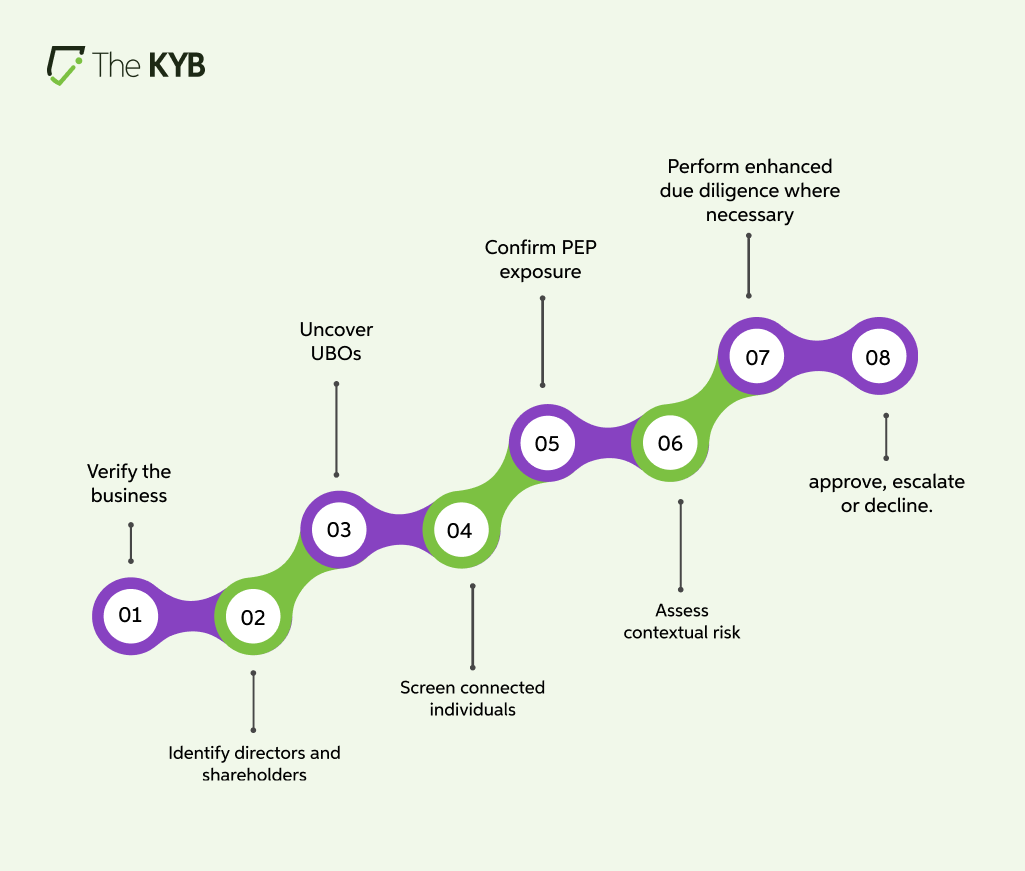
This approach gives compliance teams more evidence for their decisions than relying on a PEP match alone.
Common PEP Risk Assessment Mistakes
One of the most common mistakes is treating every PEP match as the same level of risk. Other weaknesses include screening only visible directors, failing to investigate beneficial ownership, overlooking indirect control, relying entirely on name matching and ignoring family members or close associates.
Another major problem is performing checks only at onboarding. Political positions change. Company shareholders change. New relationships emerge. Adverse information can surface after a company has already been approved.
For that reason, effective PEP risk management should include ongoing monitoring based on the organisation’s risk framework.
Strengthening PEP Risk Assessment With The KYB
PEP exposure becomes much easier to understand when individual screening is viewed alongside company information.
The KYB helps businesses verify entities, review directors and shareholders, identify ultimate beneficial owners and understand the ownership structures behind companies. Connecting this information with AML and PEP screening enables compliance teams to assess politically exposed individuals within the broader context of the business relationship.
Instead of seeing an isolated PEP match, teams can investigate who the individual is, how they are connected to the company and whether that connection changes the entity’s overall risk profile.
This creates a more informed approach to business onboarding and ongoing monitoring. Book a demo or contact The KYB’s team today!