

A business document can be genuine and fraudulent at the same time. A company registration certificate may have been legitimately issued. The layout may be correct. The logo, signature and formatting may all appear authentic. Yet a registration number, director name, ownership percentage or date could have been changed after the document was created.
That is what makes document manipulation difficult to identify.
Document tampering detection can be used by organisations to determine whether the information contained in a submitted document has been altered. The more sophisticated the manipulation technique, the less reliable the verification process when relying solely on visual inspection.
For businesses that perform business verification, the issue isn’t just to decide whether a document is legitimate or not. It is determining whether the info in it can be independently verified.
What Is Document Tampering Detection?
Document tampering detection is the process of identifying suspicious or unauthorised modifications made to a digital, scanned or electronic document.
Unlike a document created entirely from scratch, a tampered document may begin as a legitimate record. A fraudster changes only the information necessary to support a false business claim.
That could include altering:
- Legal business names
- Company registration numbers
- Incorporation dates
- Registered addresses
- Director information
- Shareholder details
- Ownership percentages
- Financial figures
- Licence expiry dates
- Signatures or official seals
Because much of the original document remains legitimate, the manipulation can be difficult for a reviewer to identify.
This is where document fraud detection becomes particularly important. Instead of treating the document itself as proof, verification teams need to examine the file, its information and independent business data for inconsistencies.
False Business Documents Can Create Real Financial Exposure
Document fraud is not limited to obviously fabricated paperwork. False or manipulated corporate information can be used to create the appearance of a legitimate business and influence financial decisions.
A more recent case illustrates how false corporate information can also enter official records.
In May 2026, Singapore’s Accounting and Corporate Regulatory Authority, ACRA, reported that an individual was convicted on 12 counts of authorising false corporate filings involving 12 companies. The filings falsely represented that another individual had consented to act as a company director. The offender received a total fine of S$108,000 and was disqualified from company management for five years.
These cases show why document verification cannot end with appearance. A document may look convincing while the information contained within it is false, altered or inconsistent with authoritative records.
The better question is: “Can the information in this document be independently verified?”
How Are Business Documents Tampered With?
Not every fraudulent document is created from scratch. A legitimate corporate document can be downloaded, scanned or obtained from another source and selectively modified.
A fraudster might change a director’s name while leaving registration information intact. A shareholder percentage could be adjusted to obscure beneficial ownership. An expired licence could be given a new expiry date.
These small modifications make effective document tampering detection more challenging because most of the information remains unchanged.
Fraudsters may also combine genuine and fabricated information. The resulting document contains enough legitimate details to appear credible during a superficial review.
Detecting these changes requires more than checking whether the document looks professional.
1. Examine File Structure and Metadata
Digital documents contain information beyond what appears on the page. PDFs and other electronic files can include details such as:
- Creation dates
- Modification timestamps
- Editing software information
- Document properties
- Embedded objects
- Image layers
- Font information
Metadata alone cannot prove fraud. A legitimate file may pass through several systems before reaching a compliance team. However, unexpected inconsistencies can create useful investigation signals.
For example, an official record said to have been downloaded directly from a registry may require additional review if its properties indicate that it was subsequently modified using editing software.
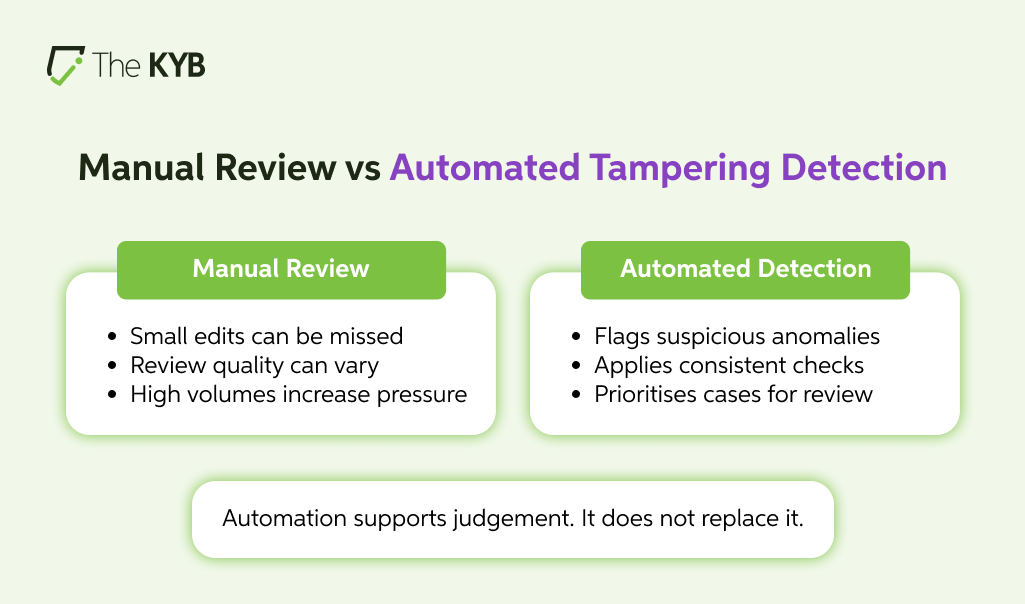
Automated document tampering detection can help identify these signals systematically instead of relying entirely on a reviewer to notice them manually.
2. Identify Visual Editing Anomalies
Some document alterations leave visible clues. A reviewer or document fraud detection tool may look for:
- Inconsistent fonts
- Irregular character spacing
- Misaligned fields
- Different text sharpness
- Uneven backgrounds
- Changes in image quality
- Modified signatures or seals
- Abnormal line spacing
- Inconsistent compression patterns
Consider a scanned incorporation certificate where almost every field contains the natural texture of the scan, but the registration number appears noticeably sharper.
That does not automatically prove manipulation. It does indicate that the field deserves closer investigation.
Multiple signals should be used rather than determining that a document is a forgery based on a single visual anomaly.
3. Check the Document’s Internal Logic
Even though a document looks polished, it can have information that doesn’t make sense. Internal consistency checks may identify issues that are not evident during a visual inspection.
For instance, a company may state its incorporation date as 2024, but in the same document, it mentions that a corporate event took place in the year 2022.
Shareholder percentages may exceed 100%.
A registration number may not match the expected format for the jurisdiction.
A director’s name could appear differently on separate pages.
Financial totals may not correspond with the figures underneath them.
Good document fraud detection software should support the analysis of document information as data, not simply as an image.
The goal is not only to find editing marks.
It is to identify contradictions.
4. Compare Information Across Documents
Manipulating one document is easier than keeping false information consistent across several records.
This makes cross document comparison valuable for document fraud detection.
Suppose an applicant submits:
- A registration certificate showing one address.
- A tax document showing another.
- A shareholder filing listing two directors.
- A business licence identifying three.
Each document may appear convincing when reviewed independently. Viewed together, the discrepancies create questions that need to be resolved.
Automated document tampering detection can support this process by extracting relevant fields and highlighting inconsistencies between submitted records.
For higher risk onboarding, those discrepancies can then be investigated before verification is completed.
5. Compare Submitted Information With Authoritative Sources
Some of the strongest evidence of document manipulation may not exist inside the document itself.
It may emerge when the submitted information is compared with an independent corporate source.
Imagine an applicant submits documentation stating:

But an authoritative corporate registry may show a different director, a different registered office, or a different register of directors, or indicate that the company is inactive.
A difference doesn’t necessarily constitute tampering. Business data may vary, and details may become available at various times.
However, it gives a good reason to investigate.
This is an important part of document fraud detection because the uploaded document represents what the applicant claims, while authoritative records provide an independent source against which that claim can be tested.
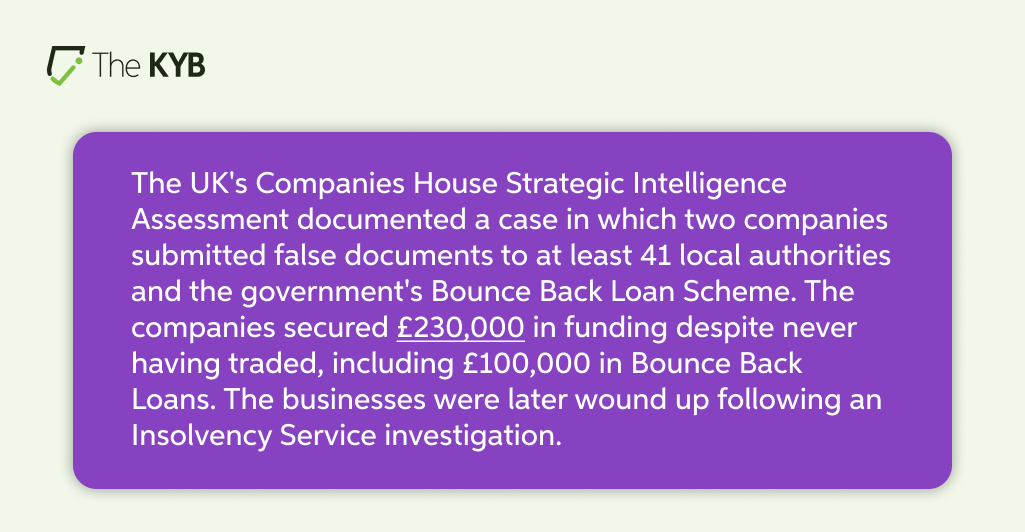
The Companies House case provides a practical reminder of why this matters. False documents were submitted across numerous public authorities and used to secure substantial funding. Independent verification of business information adds another layer between a submitted claim and a verification decision.
6. Account for AI Generated Document Fraud
Generative AI introduces another challenge. Fraudulent documents no longer need to be created by manually editing one field at a time. Generative systems can produce coherent layouts, recreate visual elements and generate polished synthetic material.
This makes appearance a weaker basis for determining authenticity.
A compliance reviewer may struggle to distinguish a convincing synthetic document from a legitimate one based on visuals alone.
Modern document fraud detection software therefore needs to support more than visual anomaly detection.
A stronger approach brings together:
- Data extraction
- Metadata examination
- Structural analysis
- Internal consistency checks
- Cross document comparison
- Corporate registry validation
- Ownership verification
- Risk based escalation
Even a flawless looking document can contain information that cannot be independently supported.
As document generation becomes more sophisticated, verification increasingly becomes a question of evidence rather than appearance.
What Should a Document Fraud Detection Tool Look For?
Choosing a document fraud detection tool should involve more than asking whether it can identify an edited image.
Organisations should consider whether the technology can support several layers of analysis, including:
- Visual manipulation indicators
- File and metadata examination
- Structured data extraction
- Internal consistency checks
- Cross document comparisons
- Validation against independent data
- Clear risk indicators
- Manual review escalation
The value of a document fraud detection software solution increases when suspicious information can be examined within a broader business verification workflow.
An altered director name matters more when it can be compared against registry data.
A questionable registration number matters more when the organisation can independently establish whether that number belongs to the claimed business.
Detection and verification work better together.
What Should Happen When Document Tampering Is Suspected?
Finding an inconsistency should trigger investigation rather than an immediate fraud conclusion. A structured workflow can include:
- Identify the suspicious field or anomaly.
- Compare it with other submitted records.
- Validate company information against authoritative corporate data.
- Verify directors and ownership information.
- Retrieve official corporate filings where available.
- Request clarification or additional evidence when required.
- Escalate higher risk discrepancies for enhanced due diligence.
This approach helps organisations avoid both missed fraud and unnecessary rejection of legitimate businesses because of harmless inconsistencies.
Where Document Tampering Detection Fits Into KYB
Document analysis and KYB solve related but different problems. Document analysis asks:
Has something suspicious happened to this document or its information?
KYB asks:
Does the submitted information correspond with a legitimate business and authoritative corporate records?
That distinction matters. The KYB enables organisations to verify company information against corporate registries and reliable business data sources. Verification can help organisations examine registration details, legal entity information, registered addresses, business status, directors, management and beneficial ownership information.
This provides an additional layer when information contained within a submitted document appears suspicious.
Rather than allowing the uploaded document to become its own source of truth, organizations can compare its claims with independently obtained business records.
The ACRA enforcement case illustrates why this distinction is important. Information submitted through corporate filings can itself be materially false. Verification therefore needs to consider not just the existence of a record but whether different pieces of evidence support the same business identity and corporate relationships.
Combining document tampering detection with wider KYB checks creates a stronger verification process than relying on either layer alone.
The KYB helps strengthen the verification layer by enabling organizations to examine the business facts behind submitted information. Do not stop at checking the document. Verify the business behind it.