

A deal rarely falls apart because someone forgot to check the obvious. The bigger problems are usually buried in how the business actually works.
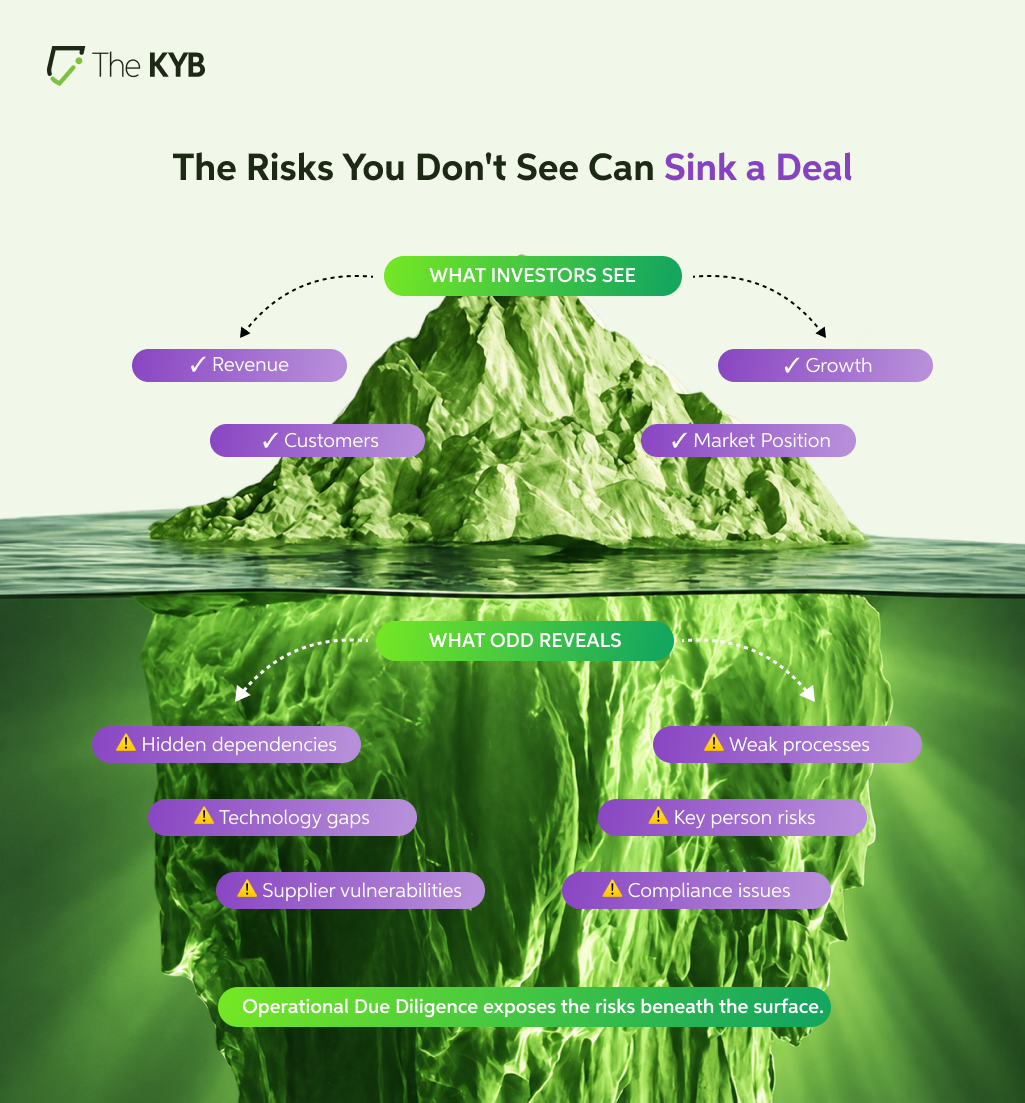
A critical process may depend on one employee. A key supplier may have no backup. Technology that supports today’s workload may struggle after an acquisition. Internal controls may exist on paper but fail under pressure.
Operational due diligence is meant to address such types of disputes.
Rather than focusing only on financial performance or legal documentation, operational due diligence examines the systems, people, processes and dependencies that keep a business running. In an M&A transaction, it can help you understand the acquisition and how to operate, scale, and integrate it after the transaction closes.
That makes operational due diligence less about asking whether a business works today and more about answering a harder question: Will it still work when the conditions around it change?
What Is Operational Due Diligence?
Operational due diligence involves assessing the company’s operational capabilities, infrastructure, and controls needed to operate and support future growth reliably.
Rather than focusing on business income, profitability, or liabilities, it focuses on how the business creates and delivers its products or services.
An operational due diligence review may assess areas such as:
- Business processes and workflows
- Management and workforce structure
- Technology infrastructure
- Cybersecurity
- Suppliers and third parties
- Operational resilience
- Regulatory compliance
- Internal controls
- Data management
- Customer and supplier concentration
The purpose is not simply to identify what is working today. It is to understand whether the company can continue operating effectively when ownership changes, demand increases or unexpected disruption occurs.
Here are ten important areas businesses should review.
1. Verify the Business and Ownership Structure
Operational assessment should begin with a clear understanding of the company itself. Businesses should verify the legal entity, registration status, operating jurisdictions, directors, shareholders and ultimate beneficial owners. Parent companies, subsidiaries and related entities should also be identified where relevant.
Complex corporate structures are not automatically problematic. However, unclear ownership or inconsistencies between company records can create legal, compliance and operational concerns.
Business verification therefore provides an important foundation for broader operational due diligence.
2. Assess Management and Key Person Risk
The human resource component for strong operations is crucial. The company’s leadership, decision making and succession planning should be a part of due diligence.
A key factor to consider is key person dependency.
If one founder controls major relationships, one engineer understands the entire technology stack, or one employee manages a critical operational process, the business may face disruption if that individual leaves.
The review should identify whether responsibilities are shared appropriately and whether critical knowledge is documented across the organisation.
3. Review Core Operational Processes
Understanding how a company actually delivers its product or service is central to operational due diligence. Review major workflows such as:
- Procurement
- Production
- Service delivery
- Customer support
- Quality assurance
- Internal approvals
- Order management
The objective is to identify bottlenecks, excessive manual work, poorly documented procedures and other single points of failure.
A process may work effectively at the company’s current size but become difficult to manage as transaction volumes or customer numbers increase.
4. Examine Technology and IT Infrastructure
Most modern businesses depend heavily on technology. Operational due diligence should therefore assess the systems that support core business activities.
This may include cloud infrastructure, internal applications, software integrations, access management, system availability and legacy technology.
Scalability is relevant especially in the context of acquisitions. The buyer should know whether existing systems can accommodate future expansion or whether a heavy technology investment is required after the transaction closes.
5. Evaluate Cybersecurity and Data Protection
Cybersecurity failures can quickly become operational failures. A serious breach may interrupt services, expose customer information and create regulatory consequences. Operational reviews should consider:
- Authentication and access controls
- Encryption practices
- Security monitoring
- Incident response
- Vulnerability testing
- Backup procedures
- Historical breaches
- Data storage and access
Companies that handle financial, identity or other sensitive information may require more extensive security assessment.
6. Assess Financial Stability From an Operational Perspective
Financial due diligence and operational due diligence overlap in some areas, but they ask different questions. Financial analysis may focus on revenue, profit, debt and historical financial performance.
Operational analysis asks how financial conditions could affect the company’s ability to continue operating. For example, a company may depend heavily on one major customer. Losing that customer could create both a financial problem and an operational one.
Other issues may include limited cash reserves, high supplier concentration, increasing operating costs or dependence on continued external funding.
7. Review Supplier and Third Party Dependencies
Companies increasingly rely on external providers for critical parts of their operations. These may include cloud providers, logistics companies, payment processors, data suppliers, technology platforms and outsourced teams.
Due diligence should identify which providers are essential and assess what would happen if one of them became unavailable.
Businesses should also examine whether critical activities are subcontracted further.
Operational risk may extend beyond the company itself to third parties and even the suppliers used by those third parties.
8. Test Business Continuity and Operational Resilience
A company should be prepared for unexpected disruption. Operational due diligence should examine business continuity and disaster recovery arrangements to determine whether the organisation can maintain important services during an incident.
Areas to consider include:
- Backup systems
- Data recovery
- Alternative suppliers
- Crisis communication
- System redundancy
- Incident escalation
- Recovery objectives
Simply having a business continuity policy is not enough. The stronger question is whether the company has tested the plan and demonstrated that its critical systems and processes can actually recover.
9. Review Compliance and Internal Controls
Weak controls can expose a business to operational losses, fraud and regulatory action. Depending on the industry, reviewers may examine licences, regulatory registrations, AML controls, sanctions processes, data protection obligations and internal audit procedures.
Internal operational controls are equally important. These may include approval processes, segregation of duties, reconciliation procedures and audit trails.
A mature control environment should prevent one individual from having unchecked authority over critical activities.
10. Investigate Reputation and Previous Incidents
Operational due diligence should not rely entirely on information supplied by management. External research can help identify issues including:
- Regulatory enforcement
- Litigation
- Cybersecurity incidents
- Service outages
- Fraud allegations
- Customer complaints
- Adverse media
- Leadership controversies
The existence of an incident does not necessarily mean the company presents unacceptable risk. What matters is how serious the event was, how management responded and whether appropriate remediation followed.
M&A Operational Due Diligence: Why It Matters
M&A operational due diligence is especially important because buyers are not simply purchasing financial performance. They are acquiring the systems, teams, processes and dependencies required to keep the company operating after the deal closes.
A thorough review can help buyers determine whether:
- The business can scale
- Additional technology investment will be required
- Operational costs may increase
- Important employees could leave
- Integration with the buyer will be difficult
- Supplier dependencies create hidden risks
- Expected synergies are realistic
In this sense, financial due diligence may show what a company has achieved while operational due diligence helps explain whether those results can continue.
What Is Operational Due Diligence Software?
Operational due diligence software helps organisations organise, assess and monitor information gathered during the due diligence process.
Depending on the platform, this may include document collection, risk scoring, business verification, ownership checks, screening, workflow management, audit trails and ongoing monitoring.
Technology can make due diligence more efficient, particularly when organisations need to review large numbers of businesses or third parties. However, software should support professional judgement rather than replace it.
Automated checks may identify ownership changes or risk signals, but teams still need to understand the operational significance of those findings.
When Is an Operational Due Diligence Service Useful?
An operational due diligence service typically involves external specialists assessing a company’s processes, technology, controls and operational risks. This may be useful when a transaction involves:
- A large or complex acquisition
- Multiple jurisdictions
- Limited internal due diligence expertise
- Highly regulated industries
- Complex technology infrastructure
- Significant third party dependencies
Software and services therefore serve different purposes. Operational due diligence software can help internal teams structure and automate parts of the process, while a specialist service provides external expertise and deeper assessment.
Why Business Verification Matters in Operational Due Diligence
Before organisations assess whether a company can operate reliably, they need confidence that they understand exactly which business they are assessing.
That includes verifying its legal identity, registration status, ownership, directors and corporate structure.
The KYB checks can support this foundation by helping organisations establish who owns and controls a business and identify relevant risk indicators.
From there, operational due diligence can go deeper into the systems, people, processes and dependencies that determine whether the company can continue performing.
Operational conditions can also change after a deal is completed. Ownership may change, directors can leave, new suppliers may be introduced, and regulatory issues can emerge.
For that reason, the strongest due diligence programmes do not treat assessment as a one time exercise. They combine careful pre deal investigation with ongoing monitoring of the businesses and relationships that matter most. Book a demo or visit The KYB’s website today!