Business verification is indisputably a part of contemporary due diligence. Organizations must first be assured of the authenticity of the companies they do business with before committing to vendor, supplier, partnership, merchant, or corporate contracts.
Typically, this confidence is derived from Know Your Business (KYB) processes. Companies verify registration information, conduct due diligence on incorporation documents and existing business relationships, as well as on beneficial owners. Additionally, they ensure regulatory compliance before entering into a business relationship.
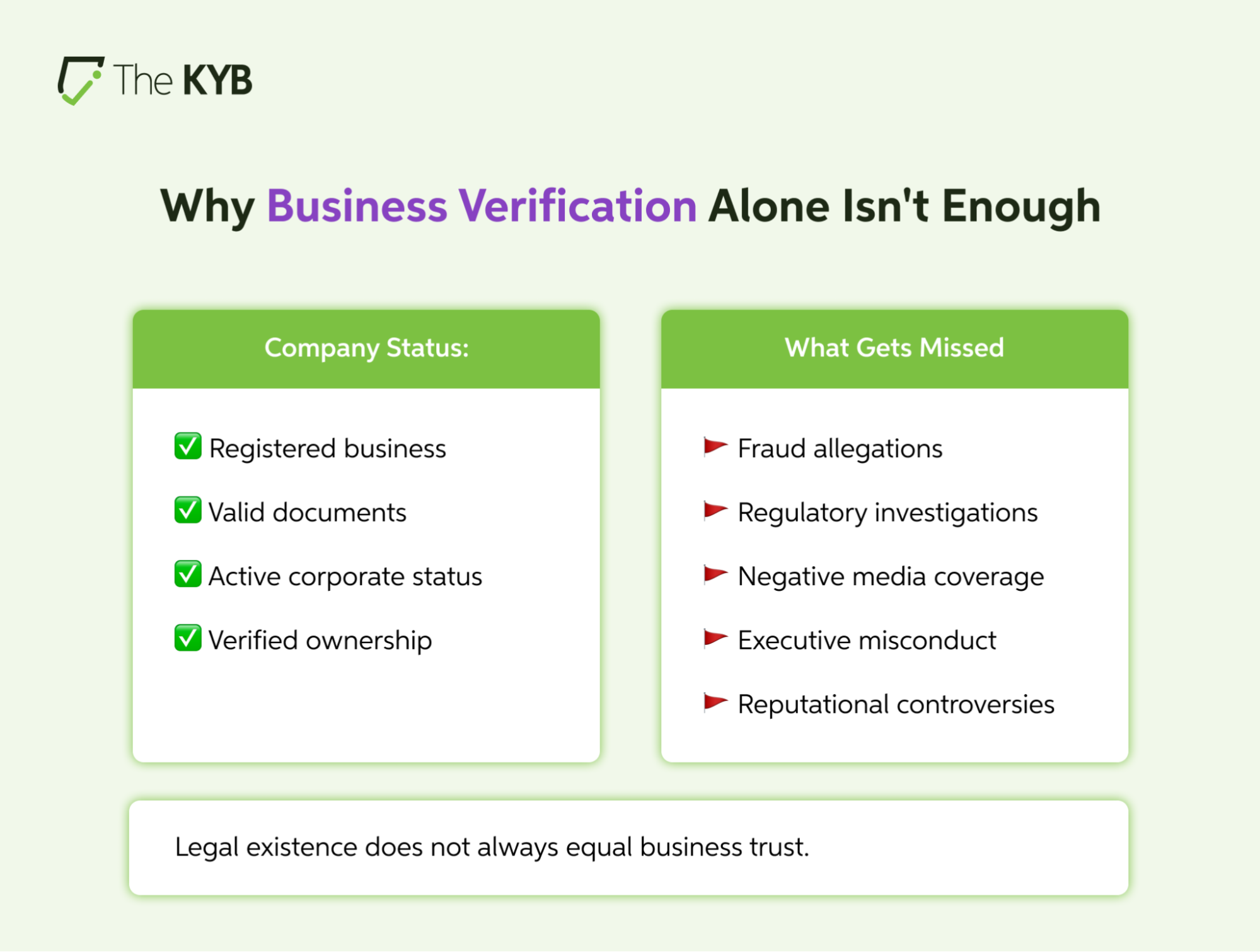
While these checks are still important, they may not be comprehensive checks. The company can look like a “real business” on the surface, but it has real issues with its reputation.
Regulatory investigations, allegations of fraud, unethical business practices, or negative public exposure can also occur outside the official corporate record. As a result, companies that rely solely on traditional verification systems may miss key indicators or warning signs.
This growing gap between business verification and business trust is driving greater interest in online reputation checks. By incorporating reputational intelligence into KYB workflows, businesses are capable of understanding not only who a business is, but also how it operates and whether it remains a trustworthy business partner in the long term.
What Is an Online Reputation Check? Explained
An online reputation check is a process of reviewing available online information to determine the risks to a business’s reputation.
These checks differ from traditional verification, which is mainly based on official documents, by also taking into account external signals that can affect a company’s risk profile.
These signals can include:
- Digital Media and News Coverage
- Regulatory announcements
- Enforcement actions
- Public business information
- Executive and ownership reputation
- Industry-related controversies
- Corporate credibility indicators
It’s not just about looking for negative information. Instead, organizations want to know whether a company’s public image aligns with its advertised functions and whether there are any concerns that require further action.
In many cases, online reputation checks add context to the traditional KYB processes that cannot be captured on their own.
Explore the Difference Between Verification and Trust
One of the most common misconceptions in business due diligence is that verification automatically creates trust.
In reality, these are two different objectives.
Verification answers questions such as:
- Does the company legally exist?
- Is it registered with the appropriate authorities?
- Who owns the business?
- Are the submitted documents authentic?
Trust requires answering additional questions:
- Has the company been linked to misconduct?
- Are there ongoing regulatory concerns?
- Have executives been involved in previous controversies?
- Is the organization attracting significant negative attention?
This separation has become more relevant as businesses operate across borders and interact with larger third-party networks.
A company can meet all the verifications but still cause significant damage to its partners’ reputations. Therefore, the trust gap is being filled with reputation intelligence as an additional form of verification.
What Online Reputation Checks Reveal
Online reputation checks can reveal threats that may not be found in a business’s files or typical compliance databases. There are several types of information that are invaluable.
-
Adverse Media and Negative News
Adverse media screening is still one of the best methods for identifying new risks.
Whether allegations or confirmed cases of fraud, corruption, money laundering, financial misconduct, or other activities that could impact a company’s reputation are made public in the news, they can have significant consequences.
Important to highlight that concerns in the media can emerge many years before any formal action is taken. Thus, adverse media serves as a warning system regarding potential risk exposure.
-
Regulatory and Enforcement Actions
Another significant reputational intelligence source is regulatory announcements.
Compliance issues or active investigations may be signaled by actions taken by financial authorities, consumer protection agencies, competition regulators, and government agencies.
By staying on top of such developments, organizations can identify companies that might need more thorough due diligence or closer monitoring.
-
Executive and Ownership Risk
Businesses rely on people to run them, and these are the ones who shape the company’s reputation. Risks can be introduced at the entity level by directors, beneficial owners, or senior executives and may not be immediately apparent.
The overall risk profile of a company may be impacted by previous enforcement or financial crimes investigations, or controversial business activities involving key stakeholders.
Reputation evaluations have gone beyond the business itself; they’re now about the people behind it.
-
Public Credibility Signals
Publicly available information can also provide valuable context regarding a company’s credibility.
For example, inconsistencies between a company’s stated activities and its public presence may warrant additional review. Similarly, misleading claims, significant public criticism, or patterns of customer complaints can indicate concerns that deserve further investigation.
Although these signals should not be evaluated in isolation, they often contribute to a broader understanding of reputational risk.
What are the Difficulties with Manual Reputation Research
Online reputation checks are useful sources of intelligence, but performing them manually comes with some challenges.
First, information is spread out in many sources. 88 may be reviewed, as well as regulatory announcements, corporate records, and public information in various jurisdictions.
Secondly, the risks to reputation change over time. One-time reviews are not enough, as new development can arise days, weeks, or months after joining.
Third, information overload may occur, especially if the organization has many business relationships.
Thus, manual reputation searching can be challenging to scale and maintain consistency and accuracy.
How Automated Reputational Risk Screening Works
To address these challenges, organizations increasingly rely on automated reputational risk screening.
Automation enables businesses to monitor large volumes of information continuously and identify relevant risk signals more efficiently.
Rather than requiring compliance teams to conduct repetitive searches, automated systems aggregate information from multiple sources and highlight developments that may require attention.
This approach offers several benefits.
Organizations can:
- Improve screening consistency
- Reduce manual workloads
- Identify emerging risks more quickly
- Support ongoing due diligence efforts
- Strengthen risk-based decision making
Most importantly, automation helps transform reputation screening from a reactive exercise into a proactive risk management process.
Why Reputation Intelligence Belongs in Modern KYB
As business relationships become more complex, organizations need greater visibility into the risks associated with the companies they onboard.
Traditional KYB remains a critical foundation. However, verification alone cannot reveal every potential threat.
Reputation intelligence complements business verification by providing insight into how a company operates beyond official records. Together, these capabilities help organizations build a more complete understanding of business risk.
A stronger KYB framework typically combines:
- Business verification
- Document retrieval
- Beneficial ownership identification
- Corporate screening
- Adverse media monitoring
- Reputational risk assessment
When these elements work together, organizations can make more informed onboarding and due diligence decisions.
From One Time Verification to Continuous Trust Assessment
A further problem with the traditional KYB is that it tends to be very onboarding centric. But the risk to reputation is not static.
Ownership structures change. New executives are established. Regulatory investigations emerge. Media coverage evolves. Initial seemingly low-risk business connections can turn into much more intricate ones over time.
Therefore, various organizations are shifting to Continuous Monitoring and perpetual KYB.
Continuous monitoring is a better approach than periodic reviews for detecting risk developments as they happen. This enables compliance teams to review and re-evaluate business relationships using the latest information rather than assumptions.
In this environment, an online reputation check is no longer a single shot but a continuous stream of information.
Building Trust With The KYB Beyond Business Verification
Checking a company’s legal existence is one of the foremost steps to address business risk. In today’s world, however, businesses require more insight into the businesses they partner with.
Online reputation checks narrow the verification-trust divide by providing information not available in corporate records. When reputation intelligence is integrated into KYB programs, organizations can be more proactive in identifying present and emerging risks. It helps them enhance their due diligence processes and make more informed decisions throughout the lifecycle of the business relationship.
The KYB supports this approach by combining business verification, document retrieval, UBO identification, corporate screening, and continuous monitoring capabilities, among others, within a single due diligence framework.
Combining Reputation Intelligence with KYB is becoming a critical aspect of responsible business verification as organizations aim to get a more comprehensive picture of business risk. Book a demo or contact our team for more information!