
A company’s registered director answers your onboarding questions. Its shareholder details match the registry. The incorporation documents appear valid. But one who wasn’t listed in those records might be running the business.
This can happen when nominee arrangements don’t align an entity’s ownership and control with the names listed in the company’s records. This is just the beginning for compliance teams when it comes to checking names on a register.
To determine if an individual recorded is acting for another party, nominee director detection and nominee shareholder detection can be used. Next, it’s important to understand this relationship and to identify the UBO.
This guide explains how nominee arrangements work, what evidence to examine and how to build a more informed KYB review.
What Is a Nominee Director?
A nominee director is an appointed director who acts on behalf of another person or entity known as the nominator. Depending on the applicable legal definition, the relationship may involve a formal obligation or an informal practice of following that party’s directions or instructions.
Singapore’s Accounting and Corporate Regulatory Authority, for example, recognises nominee relationships arising through formal or informal instructions.
However, nominee status does not remove a director’s legal responsibilities. ACRA explicitly states that directors’ duties apply to nominee directors as well as other directors. The role should therefore never be treated as simply lending a name to company paperwork.
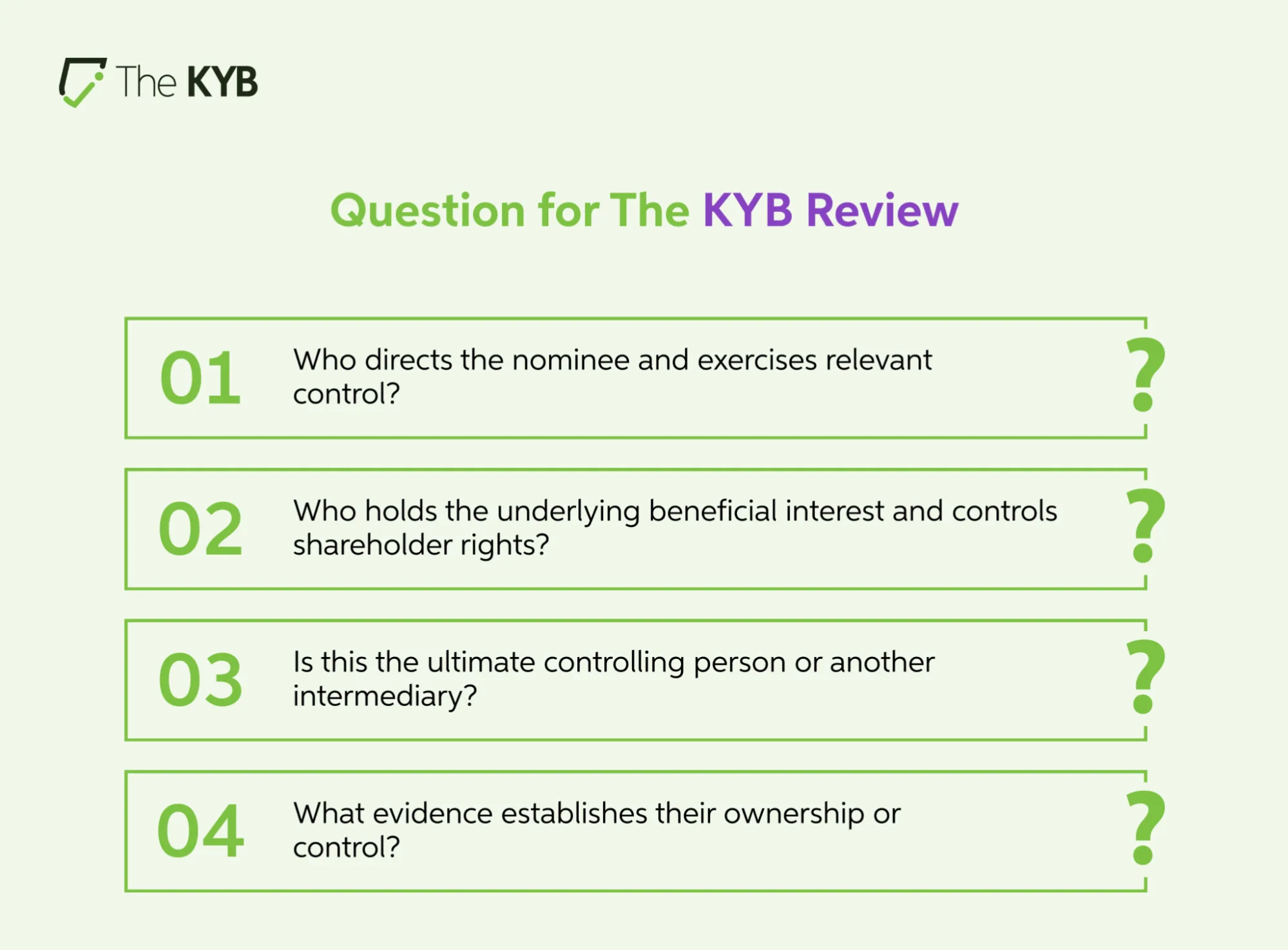
For a KYB team, the relevant questions include:
- Who arranged the appointment?
- Whose interests does the director represent?
- Who gives instructions on significant decisions?
- Is the nominee relationship disclosed?
- Does the given evidence show that anyone exercises ultimate control?
The answers can be helpful in making sure that you are not using a representative arrangement to mask the identity of the people behind a business.
What Is a Nominee Arrangement?
A nominee arrangement occurs when one party has a proper function or certain rights on behalf of another party. This can be by way of directorship or shareholding or both.
The structure may be established in contracts or through personal or business relationships. FATF beneficial ownership guidance does not exclude either formal or informal nominee structures.
To review, the compliance staff should ask the following questions: Who is in the records? Who is directing the person? Who is the owner or controller of the company?
A disclosed arrangement is used as a starting point to investigate. If the available records do not indicate compliance staff, but instead show another party, they are required to reconcile the company’s stated structure in accordance with an undisclosed arrangement.
What Is a Nominee Shareholder?
A nominee shareholder is a shareholder who acquires shares for the benefit of a third party or entity. They might be named on the shareholder register but the beneficial interest may be in the name of others.
For instance, UK beneficial ownership provisions treat shares held by a nominee as held by the individual for whom the nominee acts, for the purposes of the relevant PSC provisions. This is an example of the reasons that beneficial ownership may not be determined simply from the ownership of registered shares.
The examination of rights behind the registered holding is called nominee shareholder detection. A review should decide who is directing and benefiting from the vote, also who gets the economic benefits and who controls the transfer and disposal of the shares.
Who Is the Nominator?
The nominator is the person or entity represented by the nominee. In a nominee directorship, this is the party whose directions, instructions or wishes the director is accustomed or obliged to follow under the applicable definition.
However, determining the nominator does not necessarily complete the ownership investigation. If the nominator is another company, the review must examine that company’s ownership and control.
FATF guidance specifically addresses the need to identify the natural persons owning or controlling a legal entity that acts as nominator.
Nominee Director vs Nominee Shareholder vs Ultimate Beneficial Owner
| Role | Main function |
| Nominee director | Holds a director position while representing another party |
| Nominee shareholder | Holds shares on another party’s behalf |
| Nominator | Is the party represented by the nominee |
| Ultimate beneficial owner | Is the natural person who ultimately owns or controls the business |
The appointment of a nominee or registered shareholder does not mean that the nominee has ultimate beneficial ownership. The review is to be in relation to the relevant natural persons.
How Nominee Arrangements Can Obscure Control
Think about this example of an onboarding process. A trading company nominates a local director and the names a corporate shareholder. An onboarding individual who is not on the submitted ownership chart will look at different aspects of financing, training the director and approving contract modifications.
This does not constitute misbehaviour. It leaves an unanswered question regarding their authority.
The compliance team should ask for an explanation of the relationship, review relevant appointment and authorisation documents and determine if the individual fulfils an applicable beneficial ownership or control test.
The investigation will gain insight when it moves from records match to records and supporting evidence explain who makes decisions.
How Nominee Director Identification Works During KYB
The relationship between the recorded appointment and the actual exercise of authority should be a consideration for nominee director detection.
1. Establish the Registered Position
Check current company information and verify the director, date of appointment and record of director. While onboarding declarations are similar, they differ from this.
Record the source and the date retrieved in order to differentiate between current information and historical information.
2. Ask About Nominee Relationships Outright
Have a straightforward question for new hires regarding the roles of any directors who represent another individual or entity. If the answer is yes, ask the nominator for the details and the explanation of the arrangement.
A declaration gives a lead to an investigation. It must be evaluated with regard to the other evidence.
3. Examine Appointment and Authority over Decisions
Read through related appointment documents, board resolutions, governance documents and powers of attorney as appropriate and available.
Build can remove or appoint directors or approve major business matters or authorise to act on behalf of the company. Note any restrictions on evidence collected.
4. Reconcile the Explanation with Observed Authority
If the director is meant to make his own decisions, but the other party keeps telling him what to do, then ask the customer why he is missing the mark.
Recognize the difference between normal delegation and professional advice where someone is involved in a relevant mode of control.
5. Document the finding
Record or document all confirmed and suspected relationships, with evidence and any remaining gaps. Never nominate an unconfirmed indicator as a confirmed nominee appointment.
Beneficial Ownership Rules for Nominee Arrangements
The rules governing beneficial ownership vary from state to state. Teams should differentiate between international standards and the domestic obligations for a specific company and business relationship.
FATF standards
FATF Recommendation 24 focuses on transparency of legal persons and steps to mitigate the risks posed by nominee directors and shareholders. It provides guidance to help identify the persons behind nominee structures.
The national frameworks are based on these standards. They shouldn’t be offered as one single worldwide filing requirement.
Singapore
Relevant companies are required to submit information about their Registers of Nominee Directors and Nominee Shareholders to the central registers of ACRA, unless exempted. This filing requirement has been in effect since 16 June 2025.
Also, ACRA distinguishes between the public nominators and limited nominators’ particulars. The details of the nominator may not be public and the company company records may show a nominee.
With teams that perform business verification, that distinction counts because just being on the register doesn’t imply that there is not more information available.
United Kingdom
The PSC framework recognises that the actual underlying control of a company’s shares can be through a nominee for the purpose of the various statutory assessments under the framework. Significant influence or control may be applicable.
In teams, therefore, they should consider the applicable ownership and control conditions together with registered shareholdings.
What Should Happen When the Nominator or UBO Remains Unclear?
If an owner’s explanation is not complete, it should be an open question in the case record. Additional documents may be requested, specialist review and/or escalation of onboarding may be required depending on applicable requirements and internal procedures.
A practical case record should identify:
- The information obtained and its source.
- The parties whose identities and roles are established.
- Conflicting or missing evidence.
- Further checks requested.
- The decision and its rationale.
- Any conditions or follow-up review required.
Avoid replacing missing evidence with a confident assumption. A defensible review makes uncertainty visible and explains how it affected the decision.
How The KYB Supports Nominee and Ownership Reviews
Nominee investigations require company records, ownership information and risk findings to be assessed together.
The KYB’s UBO Identification solution supports ownership analysis using registry information, business connections and ownership visualisation. These capabilities help teams examine relationships between companies, shareholders and beneficial owners.
Corporate Screening supports AML checks on businesses and relevant company officers, shareholders and UBOs. Business Due Diligence provides additional information on key people and their roles.
These capabilities support the investigation. Establishing an undisclosed informal arrangement may still require customer explanations, supporting documents and analyst judgment.
Understand the people behind the registered roles. Book a demo with The KYB.