A business can pass an onboarding review and take on new secured financing shortly afterwards. The assets which seemed to be available in the first assessment can turn into collateral for yet another lender. Without ongoing checks, the next credit decision could rely on information that no longer reflects the business’s position.
UCC lien monitoring assists businesses in monitoring changes to public financing statements issued for their customers, borrowers and partners. These changes may require further review of collateral commitments and financing arrangements to be made.
Monitoring provides additional context beyond verification for teams that are performing business due diligence. Its value lies in understanding what has changed and whether the change affects the relationship.
What Is UCC Lien Monitoring?
UCC lien monitoring is the continuous monitoring of financing statements of the Uniform Commercial Code and other related filings on behalf of a specific debtor. It facilitates the detection of new filings and any amendments to the records throughout the year.
The Uniform Commercial Code is a uniform set of rules governing commercial transactions in the United States. A financing statement provides public notice under its notice filing system of a creditor’s or the creditor’s possible security interest in certain assets.
The underlying security agreement establishes the interest. A financing statement can sometimes be filed before that agreement is executed.
These records are often referred to as “UCC liens”, but should not be considered evidence of a loan balance or default or financial difficulty.
Monitoring can then be thought of as a process of information gathering. It identifies records that should be examined, but doesn’t make a decision on the creditworthiness of a company.
UCC Searches vs. UCC Lien Monitoring
A UCC search examines records available at a particular point in time. It can support onboarding, underwriting or a transaction review.
Monitoring repeats that process or uses a service to detect subsequent changes.
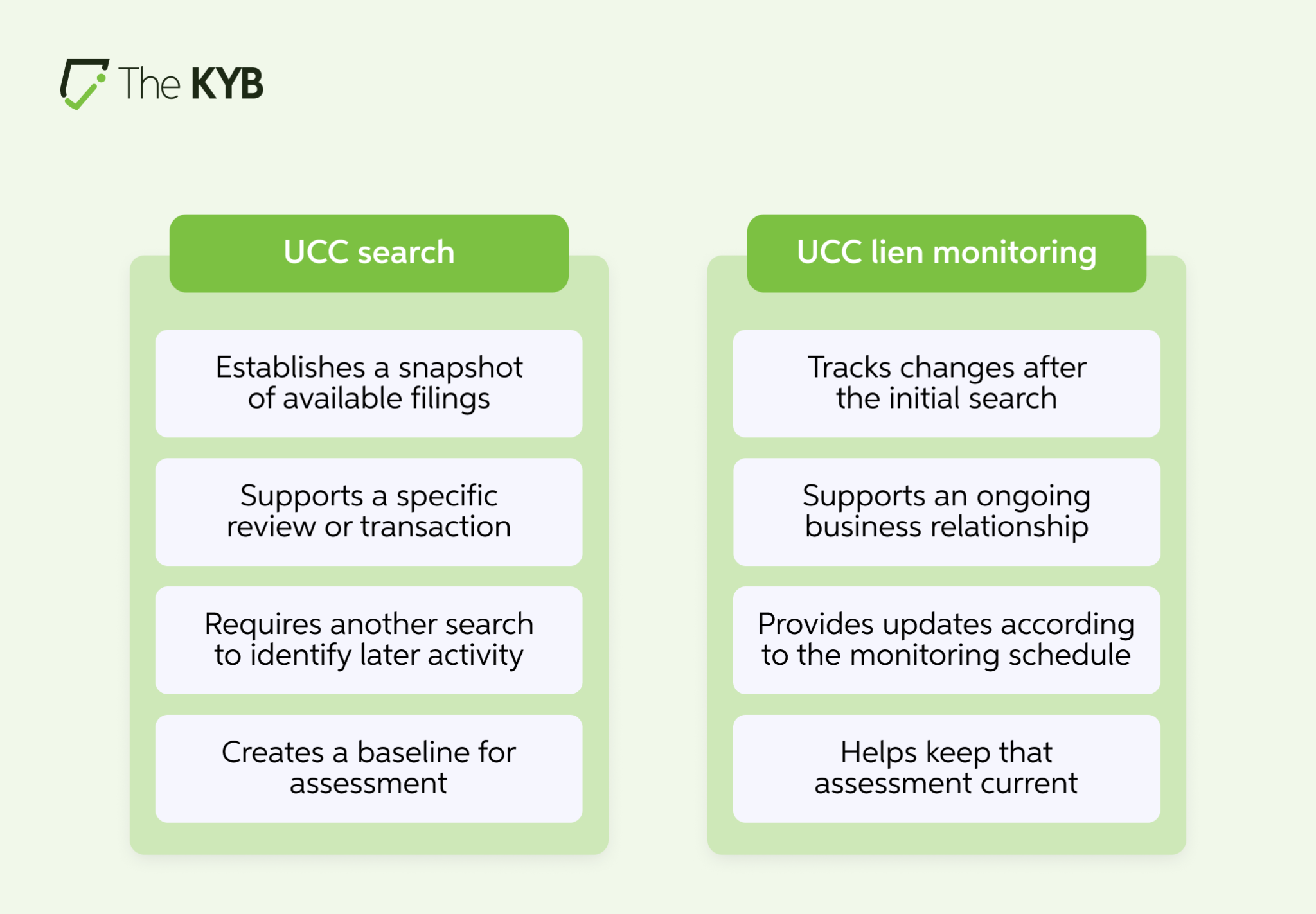
For example, a lender may review existing filings before approving financing. Later, a new filing involving the same borrower may warrant a closer look at the collateral description and loan conditions.
The initial search remains useful. Monitoring helps prevent it from becoming the only evidence used throughout the relationship.
Which UCC Filing Changes Should Businesses Monitor?
A useful monitoring process follows the complete filing history. California’s Secretary of State identifies continuations, assignments, terminations and amendments as changes handled through the UCC3 financing statement amendment form.
New Financing Statements
A new UCC1 filing can indicate a financing arrangement involving the debtor’s assets. Reviewers should examine the named parties, filing date and collateral description.
The filing may relate to routine equipment financing or working capital. Its importance depends on the transaction and existing agreements.
Amendments
An amendment may change party information or the collateral description. Teams should compare it with the original record to identify the actual change. Changes involving assets relevant to an existing credit decision deserve particular attention.
Assignments
An assignment records a change involving the secured party’s interest. Monitoring helps reviewers maintain an accurate picture of the parties associated with a filing.
Continuations and Lapse Dates
Many financing statements remain effective for five years unless continued. A continuation generally must be filed within the six months before expiration. Exceptions exist for particular transaction types, so the applicable filing rules matter.
Tracking these dates helps secured lenders manage filing deadlines. A lapse should not automatically be interpreted as repayment of the underlying obligation.
Terminations
A termination is a major change in the filing record. Reviewers should tie any comments to the relevant financing statement and scrutinise supporting information before deciding whether repayment is due or collateral is available.
Why UCC Lien Monitoring Matters for Business Due Diligence
Business verification establishes who a company is. UCC monitoring contributes information about its recorded secured financing arrangements. That information can support several decisions.
- Lending and underwriting: Filed applications could raise questions regarding further borrowing, overlapping collateral descriptions/agreements, and compliance with financing agreements.
- Trade credit: Suppliers extending payment terms may use filing changes as a reason to reassess exposure alongside payment history and financial information.
- Portfolio oversight: Monitoring can assist the teams in determining accounts that need review between scheduled assessments.
- Transaction due diligence: Buyers and investors may examine filings to understand recorded interests affecting assets involved in a transaction.
A UCC filing alone does not establish which creditor has priority. Priority analysis can include filing and perfection rules, collateral type, exceptions and agreements between creditors. Texas’s Secretary of State guidance describes both conflicting security interests and subordination arrangements.
The practical benefit is earlier visibility into changes that require investigation.
How to Build a UCC Lien Monitoring Procedure
1. Confirm the Business Identity
Begin with the company’s legal name, entity type and jurisdiction of organization. Confirm all the information against authoritative business records.
Incorrect names can create inconsistent or irrelevant outcomes. Search rules also vary. For example, Texas identifies certain business name endings that its UCC search logic ignores.
2. Identify the Relevant Filing Offices
For many registered organizations, the state of organization is relevant to the filing location. Some collateral categories require searches in other offices. Texas guidance identifies local real estate recording offices for certain fixture filings and other specified collateral. Define the search scope before relying on the results.
3. Establish a Baseline
Record existing financing statements and their associated amendments. Retain filing numbers, dates, named parties, collateral descriptions and available documents. This baseline makes later changes easier to interpret.
4. Set a Monitoring Schedule
Choose a frequency based on the business exposure and relationship. Higher exposure accounts may justify more frequent checks.
In the case of automated services, verify jurisdiction coverage, source update schedules and alert time. The alert can only be a report of information received and matched by the service.
5. Review and Escalate Changes
Assign responsibility for reviewing alerts. Define when a change requires additional documents, a conversation with the business or specialist review.
Document the evidence considered and the resulting decision. Monitoring becomes useful when someone acts on the information.
Common Challenges and Limitations
UCC monitoring depends on accurate identification and coverage of records. However, matching can be difficult because company names are similar, historical names change, and party details vary over time.
There has to be context to filing information. There may be multiple filings that refer to normal financing transactions. If the record appears to be inactive, it may need to be investigated. A financing statement will not give a full picture of what the debtor is actually owing or how he is paying it back.
A clean UCC search should therefore never be described as proof that a company has no liabilities.
Teams should assess UCC records alongside financial statements, payment behavior, business status and other relevant due diligence findings. Each source answers a different question.
Bringing UCC Monitoring into The KYB Workflow
UCC monitoring comes after business identity verification and initial risk assessment in a KYB workflow. Filing changes can then become triggers for reassessment.
The process should link each alert to the appropriate entity and ensure all evidence and material changes are preserved, with responsible review.
This allows business due diligence to be kept up to date during the relationship. If the company’s financing structure changes, the team has a clear, structured approach to determining how it affects their exposure and next move.