
A company can be registered and still have concerns in the onboarding process. Conflicting application details, unexplained activities or unresolved screening findings leave reviewers with questions that a registration check cannot answer.
Risk Assessment plays a key role in helping businesses assess potential partners, suppliers, and customers before entering into a relationship. It links verification results to acceptance criteria, giving teams a clear basis for deciding whether applications are suitable to move forward.
A lack of rules can lead to reviewers interpreting the same applicant differently. A systematic approach is needed to manage those differences effectively in a business.
The following seven steps outline the process for defining assessment criteria, reading risk signals, establishing review thresholds, and testing onboarding rules.
What Is Business Risk?
Business Risk is the probability that events, activities or relationships may adversely impact an organization’s goals, finances or operations. This business risk definition includes external and internal weaknesses and exposures.
The goal of onboarding is to assess the potential relationship. Can the applicant cause compliance issues, fail to meet its obligations or misrepresent the business that it operates?
Business verification determines facts about the organisations. Business risk analysis considers the implications of these facts for the service or relationship under consideration.
The distinction matters because a record of accuracy does not resolve all suitability issues. Assessment enables teams to reflect on the evidence available and compare it with their needs.
Seven Business Risk Assessment Steps
The following are the 7 major steps in business risk evaluation.
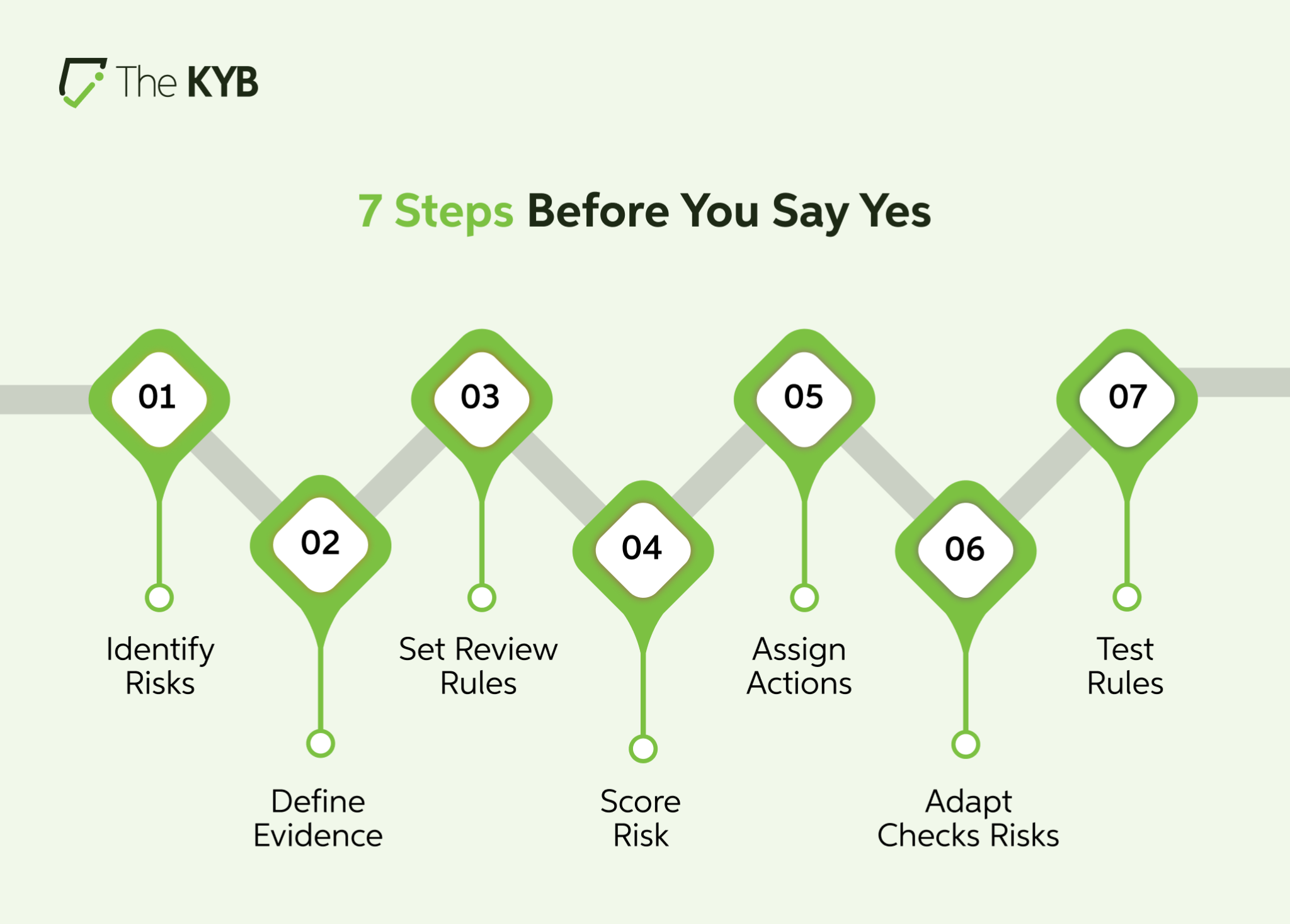
1. Identify the Types of Business Risk That Matter
Several types of business risk can influence whether a relationship is acceptable. These categories help teams organize their criteria.
- Financial risk: A customer or supplier may struggle to meet payment or delivery obligations. Where relevant, financial statements and information about outstanding liabilities can inform the review.
- Operational risk: Dependence on an unreliable partner can interrupt services or supply chains. Assess whether the business has the capacity to fulfil the proposed arrangement.
- Compliance risk: The relationship may involve restricted activities, sanctions exposure or unmet licensing requirements. Applicable restrictions need separate consideration.
- Fraud risk: An applicant may misrepresent its identity, authority or intended activities. Review inconsistencies across submitted information and independent records.
- Reputational risk: Credible reports of misconduct may affect whether the relationship fits organizational standards. Consider the source, relevance and status of allegations.
Risk in business often spans several categories, so assess their combined implications.
2. Define What Each Business Application Needs to Provide
Define the assessment and why you are doing it before setting rules. A merchant who wants to accept payments needs a different review than a supplier that sells office furniture.
Identify the product, activities to be expected, geographical exposure and customer profile. These details can set the tone for your team’s information and what concerns are most important.
Business risk assessment should also take into account the business’s ability to handle exposure. A relationship requiring extensive oversight may exceed the resources available to supervise it.
Specify what is needed to qualify for each applicant category. Delegate responsibilities for data collection, exception review, and approval.
Keep the scope specific enough that reviewers understand what a completed assessment looks like. Otherwise, applications can be transferred from team to team with no one having the questions that have yet to be resolved.
3. Turn Risk Findings Into Clear Review Rules
Each rule should identify an observable trigger and specify how it will be evaluated.
For identity discrepancies, define which differences require clarification. A trading name supported by documentation differs from a registration number associated with another entity.
For ownership, establish what evidence is needed to understand relevant owners and controllers. Specify how reviewers should handle corporate shareholders or gaps in the available structure.
For business activities, compare the declared purpose with supporting information. Ask for clarification where the proposed use of your service does not fit the company’s stated operations.
For screening findings, establish how potential matches will be investigated. Review identifying details before treating a result as relevant. Political exposure or an adverse media allegation does not automatically establish wrongdoing.
These rules make business risk analysis actionable without turning every unusual detail into an automatic rejection.
4. Set Risk Scores and Review Thresholds
Scoring can help prioritize applications, but the underlying parameters need careful design.
Assign weights according to how strongly each factor affects the proposed relationship. Document why a factor receives its weight so future changes have a clear basis.
Establish thresholds to differentiate routine processing from further review. Keep mandatory controls outside the aggregate calculation, ensuring reassuring attributes cannot cancel a restriction or required check.
Give missing information a separate status. An unavailable record should not receive the same treatment as evidence that has been checked with no relevant finding.
Avoid counting the same concern multiple times through related variables. For instance, an ownership gap and an incomplete ownership document may represent one unresolved issue.
Define how scores will be recalculated when new evidence arrives.
5. Assign an Action to Each Assessment Result
Consider two hypothetical applications that require different responses. A wholesaler submits valid company details, but the person applying cannot establish authority to represent it.
The reviewer requests evidence of authorization. Until that question is resolved, the application cannot follow the standard approval route.
A supplier has a registered address that differs from its operating address. It provides documentation explaining the distinction. Once the discrepancy is resolved and the remaining requirements are met, the application may proceed under the organization’s policy.
These business risk examples show why the next action should address the particular finding.
Assign an owner and completion criteria to each review route. Record the evidence considered and the reason for the outcome, including any approved exception.
6. Adapt Your Checks for Small Businesses
Smaller companies may have limited trading histories or less extensive documentation than established enterprises. A small business risk assessment should account for those differences when specifying acceptable evidence.
For example, a recently incorporated supplier may be unable to provide several years of financial statements. Depending on the relationship, other evidence may help assess its ability to fulfil the agreement.
Define acceptable alternatives in advance so reviewers apply consistent standards. Do not assume that company size alone establishes low risk or that limited history proves misconduct.
Proportionate checks should still address required identity, ownership and relevant screening questions.
7. Test Your Rules and Update Them When Needed
Testing helps establish whether your rules produce useful results. Select previously reviewed cases representing your customer base and compare the proposed outcomes with the evidence available.
Look for unnecessary escalations, overlooked concerns and inconsistent treatment of similar applications. Examine whether a threshold changes the review queue without improving its relevance.
Track requests for additional information, reviewer overrides and time spent resolving cases. These measures can reveal unclear instructions or unsuitable evidence requirements.
Effective risk management in business includes revisiting controls when services, customer profiles or operating conditions change. Version your rules and assign responsibility for approving revisions.
How The KYB Supports Business Risk Assessment
The KYB’s Risk Assessment solution supports configurable scoring rules, weighted parameters and defined thresholds. Its published capabilities also include automated rulesets for onboarding and enhanced due diligence decisions.
Organizations can use these capabilities to translate their assessment criteria into a repeatable workflow. Configuration should reflect the service being offered, the evidence required and the review routes established by the team.
This places onboarding within a broader business risk management process while keeping responsibility for acceptance criteria with the organization.
See how The KYB’s configurable risk assessment can support your onboarding rules. Book a demo.