
A distributor and its managing director appear in the same onboarding file, and both need screening. Yet searching their names with identical settings and reviewing their alerts in the same way can leave important questions unanswered.
The distributor has a registration number, trading names and corporate shareholders. The director has personal identifiers and a particular role within the business. Each result requires evidence suited to its subject.
Entity screening vs individual screening is therefore a practical distinction within business verification. Entity screening examines companies and other legal entities. Individual screening examines relevant people connected to those businesses.
Together, they assist teams in assessing the counterparty and understanding how ownership or management relationships affect the approval decision.
What Is Entity Screening?
Entity screening checks a legal entity against relevant sanctions, watchlists, adverse media and regulatory enforcement sources. It can cover the prospective business partner and relevant corporate entities within its ownership chain.
The subject for the screening should be well-defined. Despite the use of the same name, a company, its parent, and a subsidiary are distinct entities.
Business verification offers the registered information required to identify them. Risk records are then screened for the appropriate entity.
What Is Individual Screening Within Business Verification?
Individual screening checks relevant entities connected to the company against sanctions, PEP and adverse media sources. The persons may be beneficial owners, controllers, directors and authorised signatories as required by the requirements and business relationship.
Its purpose here is to understand exposure connected to the business. It is meaningful when reviewers identify the individual and their connection to the entity.
While a director’s past political history is one factor that must be addressed, it is not the same type of assessment that is required for a confirmed sanctions designation of a controlling owner. Those findings should not be assigned identical consequences automatically.
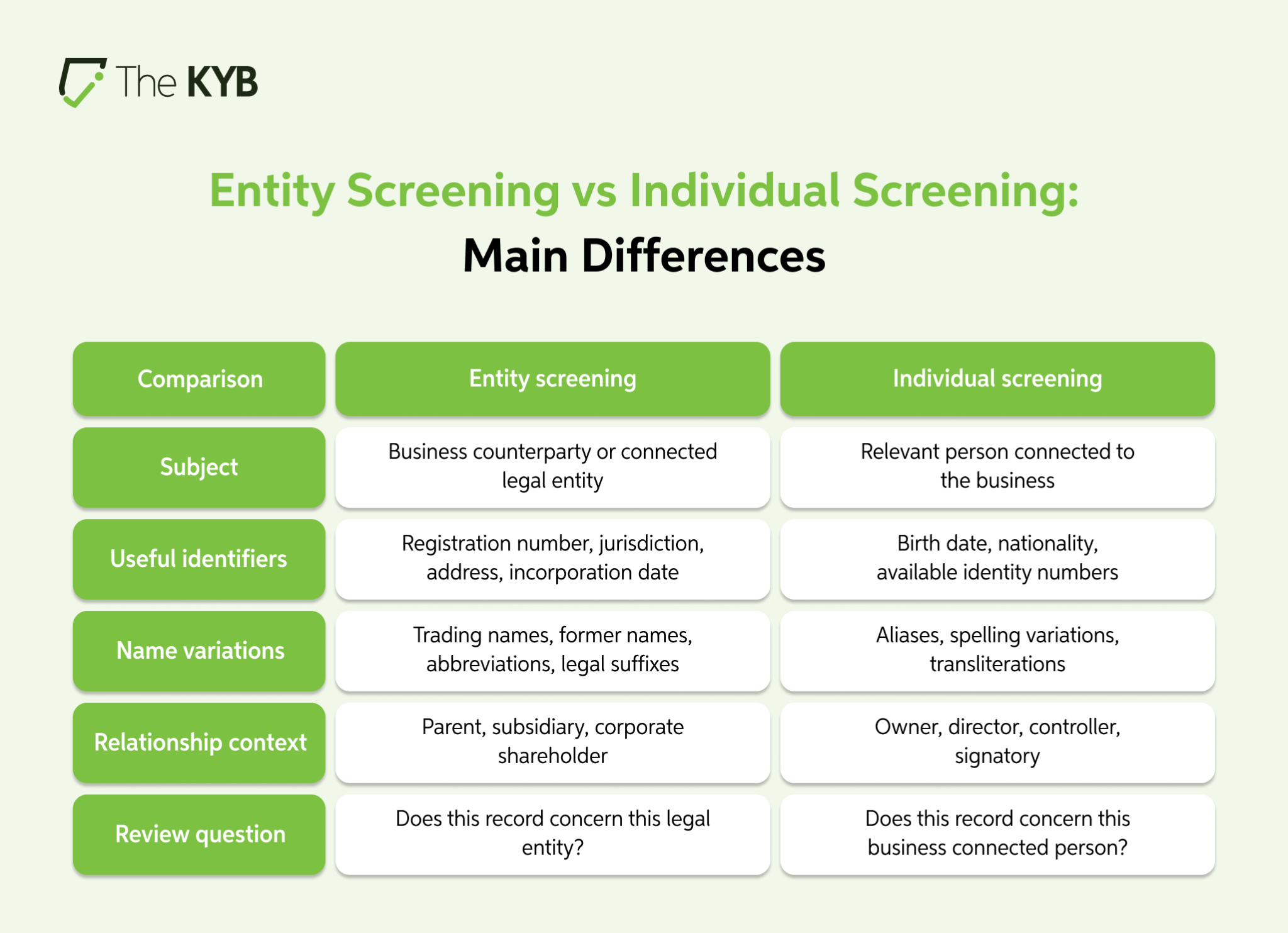
The difference has an impact on the way teams gather data, set up matching and resolve alerts. There is a need for subject appropriate review of a shared screening platform.
Different Identifiers Resolve Different Screening Matches
For business screening, a business registration number and jurisdiction may be more helpful than a familiar trading name. Where risk records contain these details, they are included to offer additional context and are provided as of incorporation dates and registered addresses.
For connected individuals, a date of birth or identity number would help identify connected citizens. Nationality and residence may be of assistance to the investigation but should be considered in relation to other evidence.
Precaution must also be taken when handling missing information. If the risk record doesn’t contain a registration number, the company match is not automatically excluded. Likewise, if the individual alert is missing a birth date, it does not resolve the alert.
Reviewers should document which identifiers agree, which conflict and which remain unavailable. That creates a defensible explanation for clearing or escalating each result.
Why Company Names Need Different Matching Rules
Corporate names often contain common terms such as trading, international or holdings. Legal suffixes add further variation. Screening should recognise relevant differences without assuming that similar core names identify the same company.
For example, Harbour Trading Ltd and Harbour Trading LLC could be unrelated businesses. Removing their suffixes may help generate potential matches, but registration details must inform resolution.
Abbreviations create another challenge. An acronym may have little textual similarity to the full registered name. Known aliases and trading name records can help establish that connection.
Personal name matching instead needs to account for naming conventions, reordered components and transliteration variants. These challenges also affect company names across languages, but their interpretation depends on the subject.
The useful principle is consistent: matching generates candidates. Evidence determines whether a candidate relates to the business or person under review.
Corporate Shareholder Screening vs UBO Screening
A corporate shareholder is a legal entity. An ultimate beneficial owner is a natural person who ultimately owns or controls the business. KYB screening may therefore require both entity and individual checks within one ownership chain.
Screening a holding company cannot substitute for UBO screening. Screening the ultimate owner also leaves questions unanswered if an intermediate corporate shareholder has relevant restrictions or enforcement history.
Ownership analysis determines how confirmed findings affect the counterparty. OFAC’s 50% Rule, for example, addresses entities owned directly or indirectly 50% or more in aggregate by blocked persons. This can create blocking consequences beyond entities explicitly named on a list.
Keep sanctions ownership analysis distinct from beneficial ownership identification thresholds. The applicable legal framework determines the assessment.
Suggested Read: UBO Identification and Business Risk Assessment: A Unified Approach
How to Review Entity and Individual Alerts Together
Consider fictional Harbour Trading Ltd. Its company name generates an adverse media alert. Its beneficial owner separately generates a potential sanctions match.
The company alert concerns a distributor with a similar name. Different registration details establish that it is another entity. The reviewer records the exclusion evidence.
The owner alert requires personal identifiers. Available information confirms a different birth date and establishes that the listed person is a namesake. That exclusion is recorded separately.
Neither outcome should be copied across the other screening record. Each subject needs its own resolution, while both results feed the business decision.
If either match remains unresolved, the reviewer should identify the missing evidence and follow the appropriate escalation process before approval.
What Should the Business Approval Record Contain?
The final record should identify each screened subject and explain how that subject connects to the counterparty. Include the company identifier, the person’s role where applicable, the source reviewed and the evidence supporting the outcome.
Separate match resolution from risk acceptance. Establishing that adverse information concerns the correct director answers an identity question. Deciding what that information means for the company requires consideration of relevance, reliability, timing and the director’s responsibilities.
A reviewer should be able to follow both steps without reconstructing the investigation. This is especially useful when another team later reviews the same business, a shareholder changes or an audit examines the original approval.
Continuous Screening: Track the Subject and the Relationship
Ongoing screening should preserve the distinction between a company’s risk record and those of its connected parties. A new company designation and a new director alert need different investigations.
Continuous screening commonly refers to automated checks against refreshed risk sources. Its effectiveness also depends on maintaining accurate relationships. A departed director and a newly appointed owner should not remain interchangeable entries in the business profile.
Record who changed, their role and when the relationship changed. Then assess relevant alerts against the current business structure.
Connect Business Verification With The KYB
The KYB supports compliance teams with business verification workflows through business verification and corporate screening across companies and relevant associated individuals. Registry information and relevant ownership details help teams place screening findings in their business context.
Explore The KYB to connect company information, ownership evidence, and screening outcomes as you review your next business relationship. Book a demo today!