


Your sales team knows the client by its brand name. The contract names a subsidiary. The registration certificate belongs to the parent company. Each record may be genuine, yet your organisation could still be unclear about which business it is onboarding.
This uncertainty can extend to screening, ownership verification and approval. A completed file provides limited assurance when it contains descriptions of different entities.
For business relationships, Know Your Client begins with establishing the legal entity behind the agreement. Business verification then connects its records, ownership and activities to a clearly defined client profile.
What Does Know Your Client Mean for Business Relationships?
Know Your Client refers to the activities required to identify a client and understand the relationship between the organisation and the client. If the client is a company, that understanding begins with the company’s legal identity.
The client is the party that should be identified in the know your client process, to whom you will provide services and will hold the relevant account. It should also describe the business and identify the actual owner or controller.
The KYB supports this work through company verification, ownership identification, and risk assessment. Individual checks remain relevant, as they relate to the entity.
You should end up with a business client profile that your teams can understand and support based on evidence.
Start With the Entity Behind the Agreement
A trading name can appear across websites, email signatures and commercial proposals without identifying the company entering the contract. Corporate groups may also operate several subsidiaries under one recognisable brand.
Consider a fictional client called Northbridge. Its website presents Northbridge Group, but the proposed agreement names Northbridge Trading Ltd. The onboarding team receives an incorporation certificate for Northbridge Holdings Ltd.
These names may represent connected companies. Their relationship still needs to be established.
A clear know your client procedure starts by recording the contracting entity’s legal name, registration number and jurisdiction. Teams can then compare these details with independent business records.
The parent company provides useful ownership context. It does not automatically substitute for verification of the subsidiary.
If several group entities will use the service, clarify which entities fall within the relationship and assess them accordingly. Recording this scope early helps prevent assumptions from spreading through the onboarding file.
Check Whether the Evidence Belongs to That Entity
Authenticity and relevance are separate questions. A genuine company document may provide reliable information about a business that is not your client.
This distinction matters when organisations share directors, addresses or branding. An address match alone may connect a document to several companies within the same group.
Effective know your client checks should compare identifying details across submitted information, registry records and contractual documents. These include:
- Registered legal name and registration number.
- Jurisdiction of incorporation.
- Current company status.
- Registered address.
- Document date and the period it covers.
Differences need context. A former company name may explain an older certificate. A recent address change may explain inconsistent records. Neither should be silently accepted or treated as automatic evidence of fraud.
For Northbridge Trading Ltd, the team should obtain evidence relating to that entity and establish why the holding company’s certificate was supplied.
Each important record should have a clear purpose within the client file.
Separate the Business from the People Acting for It
The person who will respond to onboarding questions can be a sales manager, external adviser, or group employee. Their involvement does not mean that they can legally represent the client.
Likewise, a director, shareholder and beneficial owner can have various connections with the company.
Know your client due diligence should differentiate between them. Teams must know who can communicate on behalf of the entity, who has access to the relationship, and who owns or controls it.
Evidence of authority may include relevant corporate records or an appropriate authorisation document, depending on the circumstances and applicable requirements.
Enquiry of ownership must be carried out to a sufficient degree to determine the people involved. A direct shareholder can also be a company.
In the Northbridge scenario, an employee of the parent organization would be able to coordinate the onboarding. The team should still need authority to act on behalf of the subsidiary.
Establish What the Client Relationship Will Involve
Legal identity provides the starting point. Understanding the proposed relationship gives that identity practical context.
What services does the business need? Where does it operate? What activities will it conduct through your organisation? Who is expected to make or receive payments?
The answers help teams assess whether the proposed use is consistent with the business information available.
For example, Northbridge Trading Ltd may describe itself as a domestic wholesaler while requesting services for international payments across several markets. That difference calls for clarification about its trading activities and expected counterparties.
A useful explanation should be recorded alongside supporting information where appropriate.
Know your client procedures should allow teams to investigate material inconsistencies and adjust the depth of review according to risk. Collecting more documents without resolving the underlying question adds volume while leaving uncertainty intact.
Resolve the Gaps Before Approving the Relationship
A discrepancy should lead to an investigation with a clear outcome.
For Northbridge, the reviewer might confirm the subsidiary’s registration, document its connection to the holding company and obtain evidence of the representative’s authority. The reviewer would also clarify the intended international activity.
A focused know your client checklist can help confirm that the file answers the essential questions:
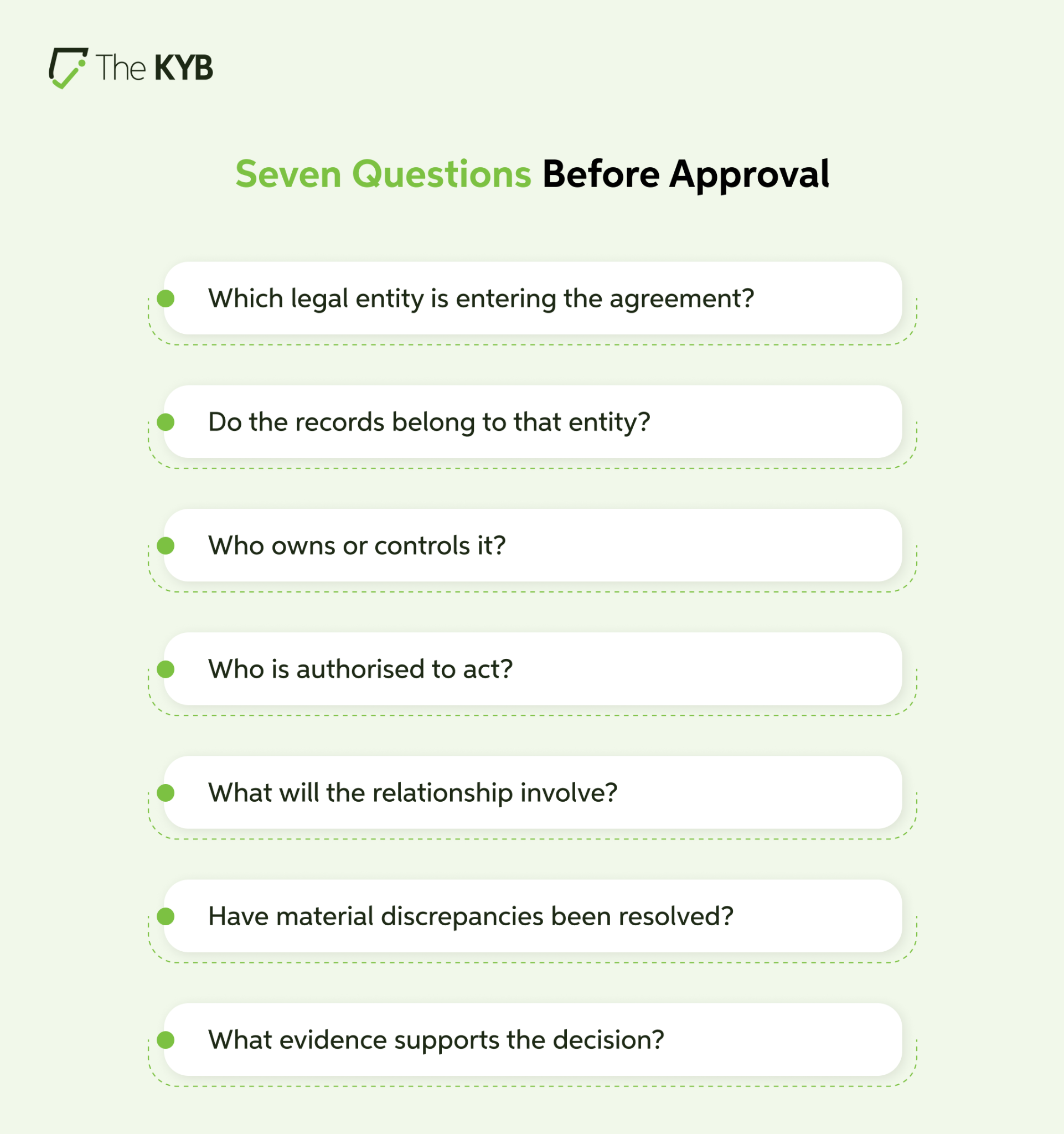
Screening findings should also be assessed against the correct entity and relevant connected parties. Similar names require careful matching before a result is attributed to the client.
The approval record should explain the decision, including unresolved limitations and any conditions imposed.
Build a Client Record Your Teams Can Rely On
A shared understanding of the business relationship should be provided on the final client record to sales, operations and compliance.
It should differentiate between the legal entity and the brand, explain relevant group connections and preserve the evidence used in the decision. Any material changes should trigger a relevant review, and the record should remain useful post-onboarding.
As you evaluate Know Your Client software, think about how it can assist your team in connecting business information to the appropriate entity. Records can be useful when reviewers can determine the relevance of the records and utilize them to answer questions.
The KYB facilitates collecting business information, verifying businesses, retrieving documents, identifying UBOs, and conducting corporate screening and risk assessment. These features enable firms to analyze the business of a potential relationship.
It’s simple for a client like Northbridge: you need to know who is being onboarded and help them recognise it with evidence.
Explore how The KYB supports business client verification at thekyb.com.