
Artificial intelligence is changing how businesses interact, transact and establish commercial relationships. AI agents can now negotiate with suppliers, initiate payments, access financial services and perform purchasing activities on behalf of individuals and organisations.
However, these capabilities introduce a new challenge for compliance teams. When an autonomous agent initiates a transaction, how can a business establish who operates it, whether its associated company is legitimate and whether it has the authority to act?
Know Your Agent (KYA) addresses this challenge by extending identity verification and business due diligence principles to autonomous digital entities.
What Does Know Your Agent Mean?
Know Your Agent (KYA) is an emerging verification framework designed to establish the identity, ownership, authority and operational boundaries of AI agents and other autonomous digital entities.
Unlike traditional identity verification, which primarily focuses on individuals or businesses, KYA examines the relationship between an autonomous agent and the entity it represents.
It involves establishing:
- The identity and authenticity of the AI agent.
- The legal entity or individual operating the agent.
- The authority granted to the agent.
- The activities and transactions it is permitted to perform.
- The accountability associated with its actions.
KYA verification helps organisations distinguish legitimate automated interactions from potentially fraudulent, compromised or unauthorised activities.
Why Know Your Agent Is Becoming Important for Businesses
Traditional commercial relationships rely on identifiable counterparties. Companies check the identity of customers, suppliers and partners before providing them with financial services or entering into contracts.
Agentic AI introduces another participant into this ecosystem. A third party that interacts with an autonomous software application may not be communicating directly with the company behind the software.
This allows for a number of new risks to arise.
- Corporate Identity Fraud
Fraudsters can deploy AI agents that impersonate legitimate businesses, submit fabricated corporate information or exploit automated onboarding systems. Without verifying the underlying business, organisations may establish relationships with fraudulent or misrepresented entities. - Unauthorised Commercial Activities
An AI agent may possess valid technical credentials but lack permission to perform a particular financial or commercial activity. For example, an agent authorised to compare supplier prices may not have the authority to approve purchases or transfer funds. - Regulatory and Accountability Gaps
Financial institutions must understand the parties involved in commercial relationships. Autonomous transactions can complicate customer due diligence, ownership identification and investigations when the responsible entity is unclear. - Scalable Financial Fraud
There are a lot of interactions that can happen within Autonomous Systems in a short time. This may be used by compromised or malicious agents to carry out onboarding fraud, payment abuse or unauthorised purchases on a large scale.
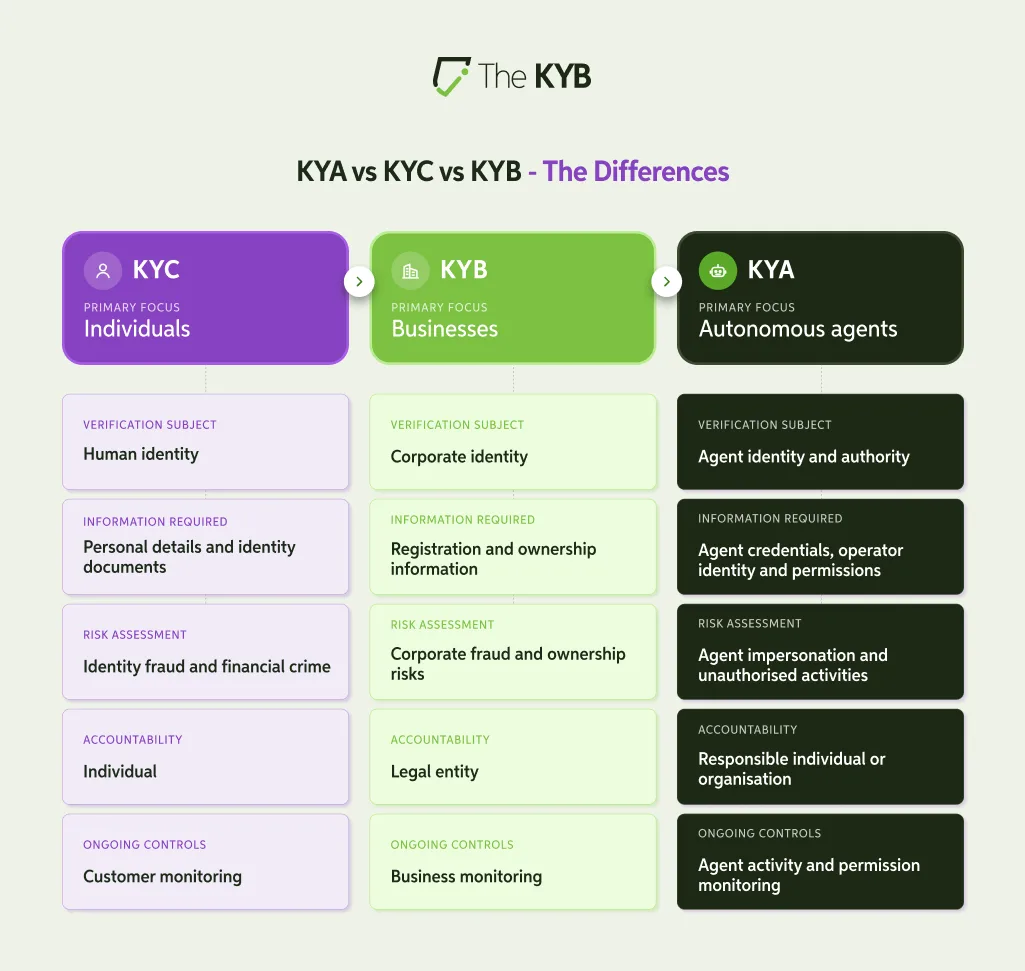
Note that KYA is not a substitute for KYC or KYB. Rather, it links autonomous systems to the trustworthy people and entities that deploy them.
Explore How AI Agent Verification Works
AI agent identity verification requires a layered approach to ensure that identity, authority, and commercial risks are independently assessed.
1. Verify the AI Agent’s Digital Identity
The process begins by establishing whether the agent is authentic and originates from a recognised source. Digital certificates, cryptographic signatures and unique identifiers can help authenticate the agent and establish the origin of its requests.
However, technical authentication does not independently establish the legitimacy of its operator.
2. Verify the Business Behind the AI Agent
Organisations must identify the legal entity responsible for operating the agent. Business verification establishes corporate legitimacy by validating information against authoritative data sources, including:
- Registered business name and registration number.
- Corporate registration status.
- Registered business address.
- Directors and shareholders.
- Ultimate beneficial owners (UBOs).
- Available corporate records.
These checks help establish whether an agent represents a legitimate and identifiable business.
3. Identify the Authorised Representative
The existence of a registered company does not establish whether a particular individual has permission to deploy an agent on its behalf. Verification should therefore establish the relationship between the responsible representative, the company and the autonomous system. Corporate authorisation records and identity verification can support this assessment.
4. Validate Delegated Authority
Organizations need to define the scope of the agent’s authority. This can include defining spending thresholds, transaction types, who funds can be spent on, and access limits.
A verified agent should not automatically receive unrestricted access to financial services or business systems.
5. Assess Financial Crime Risks
Financial crime risk should be assessed with respect to the entities and people involved with autonomous systems. Commercial relationships may be established through risk assessment, including sanctions screening, politically exposed person (PEP) checks, and adverse media screening.
6. Monitor Agent and Business Activities
Verification should continue beyond initial approval. Corporate ownership, registration status, agent permissions and operating conditions can change. Ongoing business monitoring, combined with technical activity monitoring, helps organisations identify changes that may require reassessment or access restrictions.
Applications of KYA Verification Across Industries
With the integration of autonomous systems into commercial processes, structured agent verification may benefit a number of industries.
| Industry | KYA application |
| Banking | Verifying businesses represented by agents accessing corporate financial services |
| Fintech | Establishing accountability during automated merchant onboarding |
| Payment service providers | Validating agent identities and transaction permissions |
| E-commerce marketplaces | Identifying legitimate buyers and sellers using autonomous systems |
| Procurement | Confirming corporate identity and purchasing authority |
| Insurance | Establishing accountability for automated applications and claims submissions |
Across these industries, verifying the underlying legal entity remains important for managing commercial and financial crime risks.
The Emerging Regulatory Landscape for Know Your Agent
While it is not a universal requirement currently, financial authorities and technology standardisation entities are working on mechanisms to tackle autonomous identity and governance.
The National Institute of Standards and Technology (NIST) has explored identity and authorisation practices for software and AI agents in its concept paper on the subject. Payment networks are also developing authentication mechanisms, including Visa’s Trusted Agent Protocol, which addresses recognition of agents and validation of their requests.
These developments indicate a growing focus on identity, authority, and accountability in financial autonomies.
How to Choose the Best KYA (Know Your Agent) Verification Platforms
When businesses are looking for KYA verification platforms, they need to ensure if the platform they are considering provides for technical identity and real-world business accountability.
- Global business verification: Access to authoritative corporate records across jurisdictions.
- Ownership transparency: Identification of shareholders, directors and beneficial owners where data is available.
- Agent authentication: Validation of digital identities and technical credentials.
- Authorisation management: Enforcement of delegated permissions and operational restrictions.
- AML screening: Identification of sanctions, PEP and adverse media risks.
- Continuous monitoring: Detection of changes in corporate information and agent behaviour.
- Auditability: Accessible verification and authorisation records for investigations and compliance reviews.
Depending on their operational requirements, organisations may need to integrate business verification, identity management and agent security solutions rather than rely on a single provider.
Establish Business Accountability in Agentic Commerce With The KYB
An authenticated AI agent does not necessarily represent a legitimate business. As autonomous systems enter commercial ecosystems, organisations need reliable corporate intelligence to establish who stands behind every business relationship.
The KYB supports the business verification layer of Know Your Agent frameworks by providing access to official corporate data across more than 250 countries and states.
Businesses can verify corporate registration information, examine ownership structures, identify available beneficial ownership information and conduct AML screening through a unified platform.
By integrating reliable business intelligence into AI agent verification workflows, organisations can connect autonomous commercial interactions to identifiable legal entities and make more informed risk decisions.
Book a demo to discover how The KYB can strengthen your business verification infrastructure.
Frequently Asked Questions
Is Know Your Agent a regulatory requirement?
KYA is an emerging framework rather than a universally mandated compliance requirement. However, existing AML, customer due diligence and governance obligations remain relevant to regulated organisations using AI agents.
Why is Business Verification Important for AI Agent Identity Verification?
Business verification establishes the legitimacy of the company behind an AI agent, helping organisations identify the responsible commercial entity and assess its associated financial crime risks.
Can KYB alone verify an AI agent?
No. KYB establishes corporate legitimacy, while complete agent verification also requires technical authentication, delegated authority validation and operational governance.