
A business may have a website, a strong sales pitch, and a valid registration number, but still present serious risks. It is important for you to verify that a business is what it claims to be before you hire a customer, select a supplier, or enter into a business partnership.
Vetting is the process of verifying a company’s legal status, ownership, operations, and vulnerabilities before doing business with it. An effective review also takes into account if the company can fulfil its commitments and whether those who represent the company have authority to act.
In this blog, let’s explore how to verify a company through a structured process that supports informed onboarding decisions.
What Does Vetting a Company Involve?
Vetting a company involves gathering business data about a company, verifying it with reliable sources and looking for discrepancies.
The depth of the review should reflect the relationship. A small order may not require as many checks as a merchant with a high payment volume or a partner with access to sensitive customer data.
Three activities support this assessment:
| Company verification | Whether the legal entity exists and its identifying details match reliable records |
| Company screening | Whether the business and relevant individuals have potential financial crime or reputational risk indicators |
| Business due diligence | Whether the available evidence supports entering the proposed relationship |
Business verification provides the foundation. Due diligence uses that information alongside operational, financial and risk checks to reach a decision.
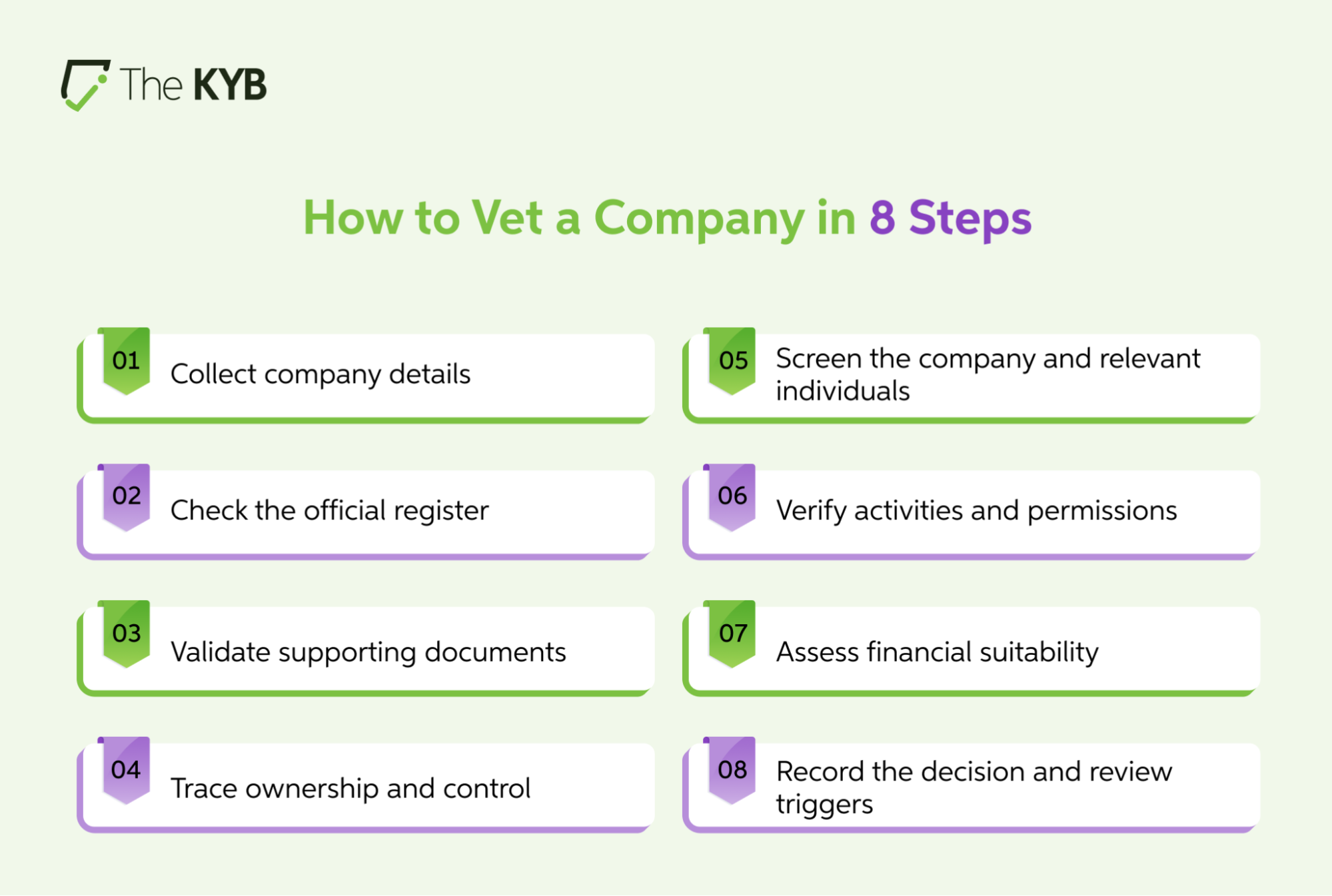
How to Vet a Company in 8 Steps
1. Collect the Company’s Identifying Information
Start by requesting enough information to identify the correct legal entity:
- Full legal name and any trading names
- Registration number
- Country of incorporation
- Registered address and operating address
- Business activities
- Names of directors and authorized representatives
- Ownership information
- Relevant licenses or permissions
A trading name may differ from the name on the company register. Confirm which entity will sign the contract, issue invoices and receive payments.
Using a registration number alongside the jurisdiction helps distinguish companies with similar names. This reduces the risk of reviewing the wrong business during the company verification process.
2. Check the Official Company Register
Search the relevant official registry to confirm the company’s existence and current status. Compare its records with the information provided during onboarding.
Look for the incorporation date, registered address, directors and available filing history. Check whether the entity is active, dissolved or subject to an insolvency process.
For example, the UK’s Companies House service provides access to registered company information, officers, document images and insolvency information. The fields available differ between jurisdictions.
Consider the registration as one component of the assessment. It does not confirm the accuracy of all commercial claims or that the business is appropriate for your intended relationship.
Record the source and date of each check so reviewers can see which evidence informed the decision.
3. Review Documents and Resolve Discrepancies
Depending on the business and its jurisdiction, supporting documents may include:
- Certificate of incorporation
- Articles of association
- Shareholder register
- Business license
- Proof of operating address
- Ownership declaration
Compare names, registration numbers, addresses and dates across these documents and registry records.
A discrepancy may have a reasonable explanation. A company could have changed its name or moved its office. Request evidence that explains the difference rather than accepting an unsupported statement.
When it comes to document based business verification, the issue is about authenticity, relevance, and timeliness of the documents for the decision. Simply receiving a document should not complete the check.
4. Identify Who Owns and Controls the Business
When performing company due diligence, the identities behind the legal entity must be determined.
Review direct shareholders and follow corporate ownership layers where necessary. If the business is owned by another company, research the other company until you can determine which people are the natural persons.
Under the KYB, an ultimate beneficial owner as the natural person who ultimately owns or controls a legal entity or arrangement.
This review includes percentages of ownership. Also consider voting rights, agreements, and other arrangements that may give a person control. Use the criteria that apply to the jurisdiction and your obligations, not one percentage as a rule of thumb.
Individually verify the negotiation or signing party’s authority to represent the company.
5. Conduct Company Screening
Business screening requires analysing potential risk factors related to the business and connected individuals.
Coverage areas include sanctions, politically exposed persons, regulatory enforcement, and adverse media, depending on the relationship and applicable requirements.
Carefully check through potential matches. Name similarity doesn’t automatically mean the listed company is the same company. Analyse identifiers such as state, city, place of registration, and any available personal information.
Any information that links to a politically exposed person should trigger a relevant risk review. It must not be assumed to be proof of bad behaviour.
If the adverse media is published, evaluate the publication, date, allegation and outcome. Differentiate between an unresolved allegation and a found allegation. Record reasons for the acceptance of a match, match dismissal, and match escalation.
6. Check the Company’s Activities and Permissions
A company background check should test whether the business’s stated activities are consistent with available evidence.
Review its website, contact details, service offering and operating locations. Where relevant, request customer or supplier references and evidence of its ability to deliver the proposed service.
If the business claims to conduct a licensed activity, verify its permission through the relevant regulator. Check the legal entity, license status and permitted activities.
A registration certificate establishes incorporation. It does not establish permission to provide every regulated service.
Also review unusual payment arrangements. If the company asks you to pay an unrelated entity, obtain and verify an explanation before doing so.
7. Assess Financial and Commercial Suitability
A business background check should consider whether the company can fulfill its commitments.
For a material relationship, review available financial statements, insolvency records, credit information or trade references. Match the evidence requested to the value and duration of the agreement.
For example, a supplier receiving a substantial advance payment may require closer financial review than one paid after delivery.
A newly incorporated company may have little financial history. That gap does not prove misconduct, but it may justify staged payments, a smaller initial contract or any further additional checks.
Assess the evidence in context. Financial information should help determine suitable terms and controls rather than produce an unexplained pass or fail.
8. Document the Decision and Plan Further Reviews
The business verification process should end with a clear decision supported by evidence.
Record:
- The checks completed and their sources
- Any unresolved discrepancies
- The risk assessment
- The approval, rejection or escalation decision
- Conditions attached to approval
- The next review date or review triggers
An approval condition may limit a service to a certain number of transactions, or require more documentation before it becomes available.
Re-evaluate the relationship if anything changes. The original decision could be impacted by changes in ownership, a shift of directors, new business activity or new risk information.
Red Flags That Need Further Investigation
Usually, warning signs include inconsistent information about the company, missing information, suspicious licenses, and intentions to skip the verification process.
Other concerns include payment requests that have unrelated beneficiaries or business activities that don’t match the proposed transaction.
A red flag is a major reason for concern. Several unresolved issues may justify escalation or rejection. Record what was found and why it matters to the relationship.
How The KYB Supports Company Vetting
The KYB supports business verification through access to company and shareholder information from official registries and other corporate data sources. Its services include business verification, ownership information and AML screening.
Its business due diligence reports also provide information on directors, shareholders and ultimate beneficial owners to support company reviews.
These capabilities help teams gather evidence for onboarding assessments. The final decision should reflect the findings, the proposed relationship and the organization’s risk criteria.
Explore The KYB’s business verification solution to support your company vetting process.